
Reviews & Guides · Instruments & Audio
Fender Acoustasonic: playing impressions for American Acoustasonic Telecaster buyers
I thought the Fender Acoustasonic would give me the best of electric and acoustic. I love the body, but the stiff feel and muddy overdrive let me down.
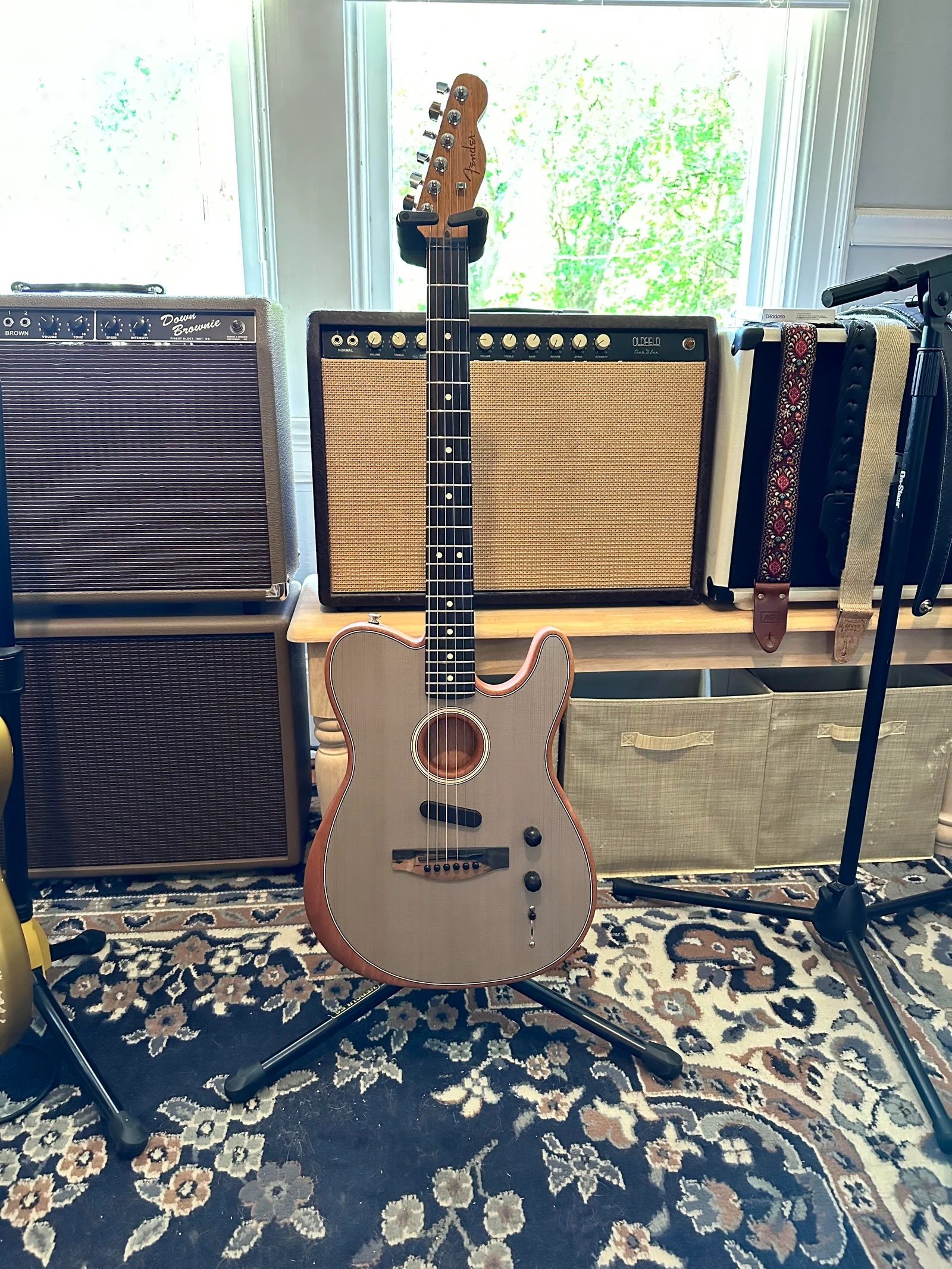
Electric or acoustic? After a proper play
I thought this would be a guitar that suited me perfectly—electric and acoustic together. After really playing it, I didn’t feel that way.
The different digitally voiced sounds were quite good through amplification, but listening in person I couldn’t make much of the distinctions. The built-in overdriven electric mode was another matter: I thought it was awful and muddy. I don’t really understand who would use it. Even gigging or recording players, I imagine, might stick to its acoustic sounds.
A body I love, a neck I don’t
I love its exposed wood grain. Bare-looking wood feels like a tough, slightly wild statement: I’m vulnerable, but I don’t need paint to protect me. To me, playing it means reducing its resale value, because some areas will polish up with use and reveal its age. On the positive side, the surface is comfortable, without drag, and the textured grain feels reassuring.
The neck isn’t my shape. It reminds me of an American Ultra, and the fretboard edges feel hard and sharp against my hand, although I think I could adapt. Both the feel and the response of the sound strike me as stiff. Perhaps it’s the acoustic strings, but it takes effort to play. The body is hollow yet the unplugged volume is small. It’s nothing like its Highway Series sibling, which I really like and plan to write about later. Even amplified, the response still feels hard to me, not particularly comfortable.
My verdict
7.5 out of 10. The electronics aren’t my thing, but other parts are good, particularly the body. I’ve heard that solid-body electric guitars were developed for performance and feedback control. This specially designed body serves the same purpose, so isn’t that retro?
Source: 小耶胡 · Xiaohongshu · 12 June 2025 · 电还是木?我弹 #4 Fender Acoustasonic. Search this Chinese title in Xiaohongshu to find the original post.
Before You Buy
Models in your region
The photograph shows a Telecaster-shaped Acoustasonic. The owner does not give a serial number or full series name, so the American model below is a related regional reference rather than a confirmed identification of this particular instrument.
| Model in this review | Related regional model | What to know |
|---|---|---|
| Fender Acoustasonic, Telecaster shape | American Acoustasonic Telecaster (US) | A hybrid guitar with volume, blend and five-way voice selection. |
| Fender Acoustasonic, Telecaster shape | American Acoustasonic Telecaster (UK) | The UK catalogue includes the Acoustasonic Telecaster family; check the series, year and finish of the guitar offered. |
- Model in this review
- Fender Acoustasonic, Telecaster shape
- Related regional model
- American Acoustasonic Telecaster (US)
- What to know
- A hybrid guitar with volume, blend and five-way voice selection.
- Model in this review
- Fender Acoustasonic, Telecaster shape
- Related regional model
- American Acoustasonic Telecaster (UK)
- What to know
- The UK catalogue includes the Acoustasonic Telecaster family; check the series, year and finish of the guitar offered.
Fender’s series comparison says the American configuration uses three pickups, while Player and Standard use two. Confirm the exact series and model before comparing their controls.
Choosing for everyday use
The player’s Acoustasonic experience is a reason to try both the feel and amplified sound of the related American Acoustasonic Telecaster (US/UK) before buying. Try the neck, bends and the specific electric voice you would actually use, through equipment appropriate to your playing.
The US American model specification lists a 25.5-inch scale, a Modern Deep C neck, .011–.052 phosphor-bronze strings, a satin polyester body finish and a satin urethane neck finish. The natural-looking grain is therefore not evidence that this regional model is bare, unprotected wood. Wear and resale comments in the account are the player’s expectations, not a durability study.
The owner supplies no controlled recordings or amplifier settings. Their muddy-overdrive impression cannot rank all Acoustasonic voices or predict how the instrument will sound in another signal chain. But a guitar that feels uncomfortable before plugging in deserves careful hands-on consideration, however attractive its body.
Related Reading

Reviews & Guides · Instruments & Audio
Beats Studio Pro: an owner finds balanced sound, folding storage and usable noise cancellation
I used Beats Studio Pro for international flights and found unexpectedly balanced sound, easy folding storage and useful iOS features, despite average noise cancellation.

Reviews & Guides · Instruments & Audio
Shokz OpenDots ONE: a first afternoon of calls and a 10 km run
I wore the Shokz OpenDots ONE for calls, two to three hours of comfort and a 10 km run, but still prefer bone-conduction headphones for heavy exercise.

Reviews & Guides · Instruments & Audio
Shokz OpenDots ONE (E310): two hours testing fit and sound
I wore the Shokz OpenDots ONE E310 for two hours and found strong highs and lows, stable but slightly pinching fit, and limited leakage at full volume.