1. Performance first: It must not stick easily.
2. It must not be too heavy.
3. Easy maintenance.
4. Versatile cooking uses.

See what buyers in China learned first.
Reviews & Guides · Kitchen & Dining
Reviewed: Vermicular Frying PanRegional reference: Vermicular Frying Pan 24cm Deep (US)
I test my Vermicular Frying Pan with fish, compare its lighter handling, and explain why its enamelled cast-iron design makes everyday care simpler.
1. Performance first: It must not stick easily.
2. It must not be too heavy.
3. Easy maintenance.
4. Versatile cooking uses.
Video unavailable. Please try again later.
Salut~ I'm Han. If you're thinking about buying a cast-iron frying pan, I don't think it needs to be that complicated. After using them for so many years, I've summed it up in four points. I'll share them all with you today. OK~ let's get started.
First, when it comes to frying, it shouldn't stick at the drop of a hat. I think a truly good cast-iron pan doesn't rely on a coating to be nonstick. It relies on the pan's own foundation—the body heats evenly and stays stable. It relies on the pan's own foundation, so the body heats evenly and stays stable. With that foundation, once you learn a few little tricks, you can put the food in and just add [inaudible], and it will naturally cook without sticking.
The most straightforward test is frying fish. The technique is simple: preheat the pan over medium heat. Once the pan is hot, add an appropriate amount of oil. Turn the heat to low, place the fish skin-side down, and don't rush to flip it. Wait for it to set on its own, then turn it over. See? The fish skin can basically come off in one piece [inaudible] and the bottom develops a beautiful crisp, browned layer. That's the Maillard reaction, which only a heat-resistant pan can achieve~ Once you've mastered this technique, you'll find that a cast-iron pan really does get easier and easier to use.
The second point is that it can't be too heavy, or you won't use it every day—trust me. That's also what puts me off many cast-iron pans.
[Text: Traditional model: 24 cm, 1,900 g]
Some pans really do work well, but every time you pick them up—whether you're cooking, washing them, or serving the food—they feel like a burden. Over time, they're very likely to end up sitting unused. So the one I've used more often since then keeps the qualities of cast iron, while careful craftsmanship makes the pan lighter and thinner.
[Text: Lightweight cast-iron pan: 24 cm, 1,090 g]
As a woman, I find it much easier to use. It is a little expensive, but you really do get what you pay for.
The third point is that maintenance has to be easy. Because no matter how well a pan works, if you have to spend a lot of time maintaining it after every use, honestly, I find that a bit of a hassle too. So personally, I would recommend an enameled cast-iron pan like this one. Traditional bare cast iron comes directly into contact with water and air. If you don't dry and oil it promptly after washing, it can rust very easily.
Enamel is basically a protective layer over the cast iron. It keeps out air and water, so there's no need to season the pan, and you don't have to oil it specially after use. Maintenance is so much simpler.
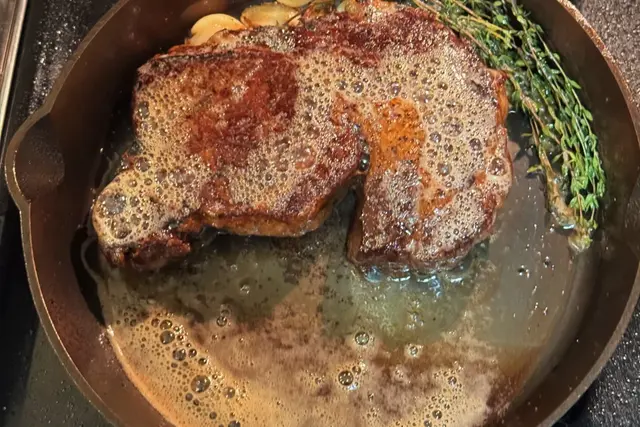
And the final thing I've learned is that ideally, it should handle both Chinese and Western cooking. The final thing I've learned is that ideally, it should handle both Chinese and Western cooking. If a pan costing over 1,000 can only be used for Western cooking, then at least for me, the value for money is a little low. So personally, I prefer one with slightly taller sides, and a flat pan around 24–26 cm in size. This size performs extremely well for searing steak. The pan conducts heat incredibly quickly, and the steak develops a beautiful crust soon after it goes in. Let me show you.
With slightly taller sides, everyday stir-frying vegetables or making fried rice is easier too, and the food won't fly out as easily. When you're stir-frying vegetables, they won't release water as easily either, so they'll have a wonderfully wok-like flavor. Fried rice comes out even better, with every grain separate, just like restaurant-style egg fried rice. It's incredibly delicious.
For me, that's what good cookware is all about: it doesn't need to be overly complicated overall. Just get every detail right. OK~ See you in the next video. Bye-bye~~
Before You Buy
Han demonstrates a wood-handled, enameled Vermicular Frying Pan labelled 24cm in the video. The table relates it to the US 24cm Deep version.
| Model in this review | Related regional model | What to know |
|---|---|---|
| Vermicular Frying Pan | Vermicular Frying Pan 24cm Deep (US) | The same wood-handled, enameled cast-iron Frying Pan family. Han’s pan is labelled 24cm and 1090g; its exact SKU and depth are unconfirmed. The US 24cm Deep is listed at 2.3lb and serves two to three people. |
Han preheats over medium heat, adds oil, lowers the heat and places the fish skin-side down. She waits for the skin to set before turning it; in the demonstration, it lifts largely intact with a crisp browned surface.
Vermicular’s Frying Pan has an enamel finish. Han contrasts it with conventional nonstick cookware and emphasizes preheating, oil and patience when releasing the fish.
The source’s scale comparison shows an unnamed traditional 24cm pan labelled 1900g and the lightweight Vermicular labelled 1090g—a difference of 810g. Han values that lower weight when cooking, washing and serving, because a cumbersome pan is more likely to sit unused.
The US Vermicular Frying Pan 24cm Deep is listed at 2.3lb and sized for two to three people. Those figures help put its capacity and handling in context alongside Han’s preference for a manageable everyday pan.
Han prefers enameled cast iron because she does not need to season it or apply oil after each use. That simpler routine is a major reason she uses this pan more often.
Vermicular’s US guide recommends preheating for about 90 seconds over medium-high heat, or 60 seconds on induction, then adding oil and waiting for smoke across the whole surface before adjusting the heat. For cleaning, use mild soap and a soft sponge; avoid abrasive cleaners, force and prolonged soaking of the wooden handle. The wood-handled Frying Pan cannot go in the oven and should not be used with metal utensils.
Han prefers slightly higher walls and a pan around 24–26cm for both Chinese and Western cooking. She uses it to sear steak and says the higher sides help contain vegetables and fried rice. Her reported results include less watery vegetables and rice with separate grains.
The related US Vermicular Frying Pan 24cm Deep has deeper walls intended for braising, deep-frying and stir-frying. It offers a local version of the mixed-use design Han values, especially when a shallow skillet would leave too little room to move food.
Reviews & Guides · Kitchen & Dining
I used my MUJI nonstick pan almost daily for a month. It felt light, heated quickly, and I noticed no peeling or sticking while using a wooden spatula.
Reviews & Guides · Kitchen & Dining
I used my Smithey No. 10 once and was surprised by the heat readings across the pan. I also share what stood out about my new kitchen pieces.
Reviews & Guides · Kitchen & Dining
I made eight small patties in my 24 cm Fissler stainless steel pan, fitting four at once, and found it manageable to toss one-handed.