
Reviews & Guides · Computing & Networking
ASUS ROG GS7 and TUF Gaming BE6500 wired AiMesh: recovering from a WAN-port fault
Reviewed: ASUS ROG GS7, ASUS TUF Gaming BE6500, ASUS RT-AX86U ProRegional reference: ASUS ROG GS7 (ROG Mohe) (China); ASUS TUF Gaming BE6500 (TUF Xiaoxuanfeng Pro WiFi7) (China); ASUS RT-AX86U Pro (US)
I replaced two RT-AX86U Pros with a ROG Mohe and TUF Xiaoxuanfeng Pro WiFi7, but wired AiMesh negotiated at 100 Mbps. A replacement fixed it.

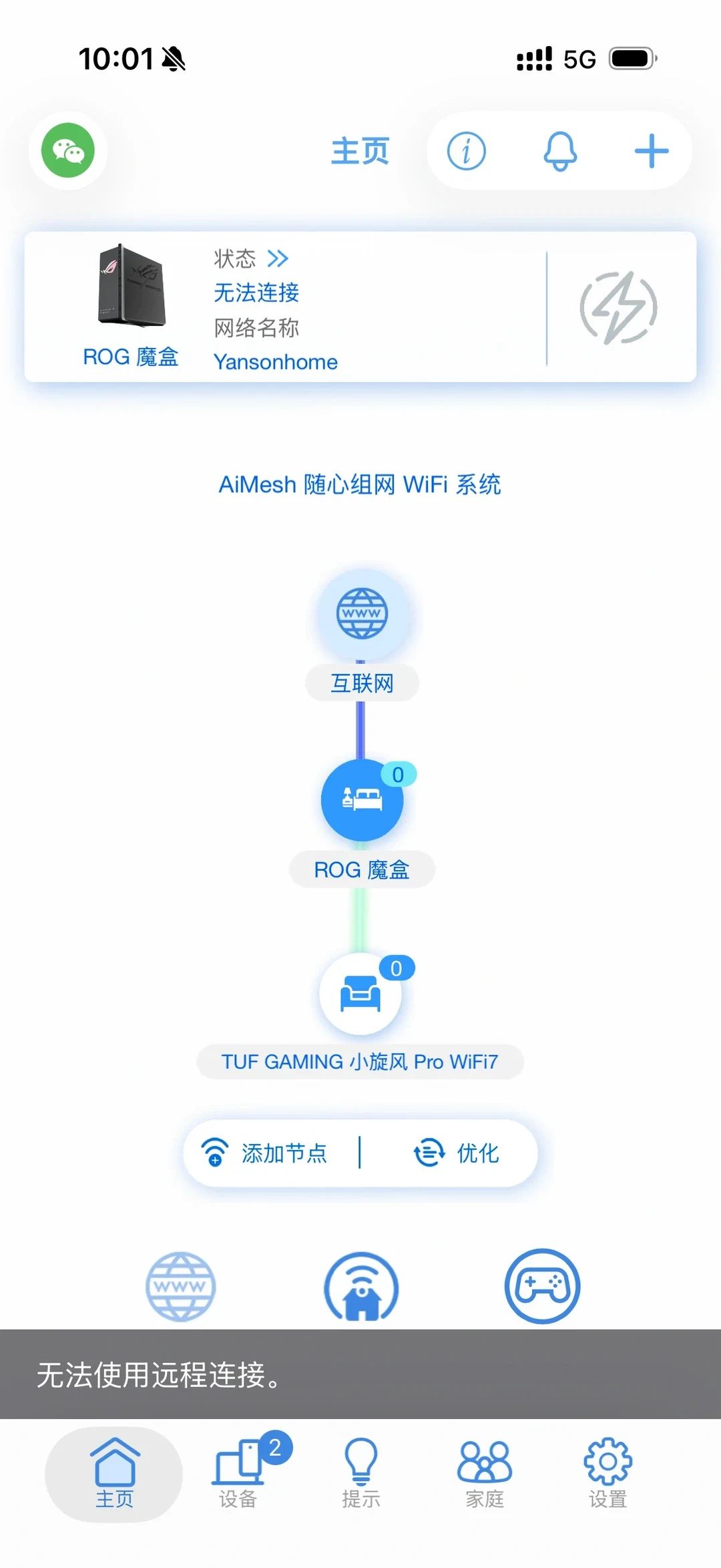
I previously used a Xiaomi router, but frequent disconnections led me to replace it with two ASUS RT-AX86U Pros in wired AiMesh. Their speed kept getting stuck at 500 Mbps, even though my home internet service is 1,000 Mbps, so I returned them and switched to a ROG Mohe and TUF Xiaoxuanfeng Pro in wired AiMesh. Here’s the problem: the fiber modem’s cable runs to the main bedroom, where the Mohe establishes the Internet connection by dial-up; an Ethernet cable then runs to the living room and the Xiaoxuanfeng Pro, and I also have a NAS connected. The previous routers, including the returned AX86U units, had 1,000 Mbps wired AiMesh links. This time, the Mohe and Xiaoxuanfeng Pro setup only negotiated at 100 Mbps. I changed the Ethernet cable, but it made no difference. I was left using 5 GHz wireless backhaul. Could this be because the 2.5G port wasn’t supported? Does anyone know what caused it?
Update: Customer service confirmed that the WAN port was faulty. I ordered a replacement and returned the old unit; the speed now meets expectations.
Source: 林 benben📷 · Xiaohongshu · 2025-11-24 · (更新后续)华硕有线aimesh 速率只有100m. Search this Chinese title in Xiaohongshu to find the original post.
Before You Buy
Models in your region
The owner’s Chinese-market names map to the ASUS ROG GS7 and TUF Gaming BE6500. The post does not show the exact hardware revisions, and its WAN-port fault was not attributed to a specific unit. The US RT-AX86U Pro is a regional product in the same named family as the owner’s earlier comparison model, but the source does not establish firmware or hardware-SKU equivalence.
| Model in this review | Related regional model | What to know |
|---|---|---|
| ASUS ROG GS7 (ROG Mohe) | ASUS ROG GS7 (ROG Mohe) (China) | ASUS’s China page identifies ROG Mohe as the GS7. The owner used it as the primary router; the source does not establish the hardware revision, so later versions’ port counts should not be assumed for this unit. |
| ASUS TUF Gaming BE6500 (TUF Xiaoxuanfeng Pro WiFi7) | ASUS TUF Gaming BE6500 (TUF Xiaoxuanfeng Pro WiFi7) (China) | ASUS identifies the China-market TUF Xiaoxuanfeng Pro WiFi7 as the TUF Gaming BE6500. The owner used it as the wired AiMesh node; no US-market renamed equivalent is established by the supplied evidence. |
| ASUS RT-AX86U Pro | ASUS RT-AX86U Pro (US) | The US listing identifies the RT-AX86U Pro family, matching the model name in the owner’s earlier comparison. It is a dual-band Wi-Fi 6 AiMesh router with a 2.5G port configurable as WAN or LAN; the owner’s exact regional SKU and firmware are unknown. |
- Model in this review
- ASUS ROG GS7 (ROG Mohe)
- Related regional model
- ASUS ROG GS7 (ROG Mohe) (China)
- What to know
- ASUS’s China page identifies ROG Mohe as the GS7. The owner used it as the primary router; the source does not establish the hardware revision, so later versions’ port counts should not be assumed for this unit.
- Model in this review
- ASUS TUF Gaming BE6500 (TUF Xiaoxuanfeng Pro WiFi7)
- Related regional model
- ASUS TUF Gaming BE6500 (TUF Xiaoxuanfeng Pro WiFi7) (China)
- What to know
- ASUS identifies the China-market TUF Xiaoxuanfeng Pro WiFi7 as the TUF Gaming BE6500. The owner used it as the wired AiMesh node; no US-market renamed equivalent is established by the supplied evidence.
- Model in this review
- ASUS RT-AX86U Pro
- Related regional model
- ASUS RT-AX86U Pro (US)
- What to know
- The US listing identifies the RT-AX86U Pro family, matching the model name in the owner’s earlier comparison. It is a dual-band Wi-Fi 6 AiMesh router with a 2.5G port configurable as WAN or LAN; the owner’s exact regional SKU and firmware are unknown.
The reported 100 Mbps link was traced to a faulty WAN port
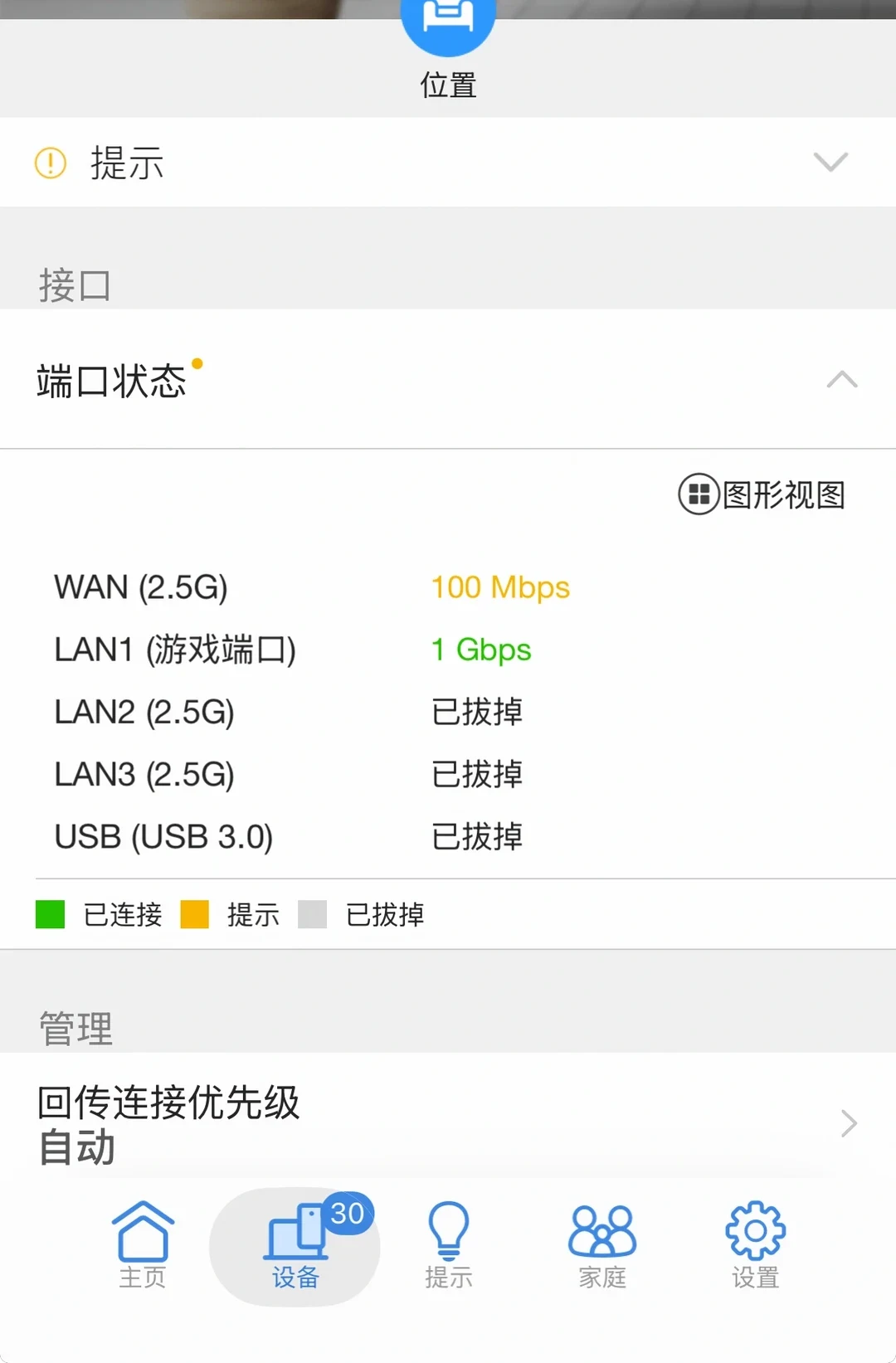
The owner initially suspected that the 2.5G port might be unsupported after the wired AiMesh link negotiated at 100 Mbps, even with a different cable. The later update changes the practical takeaway: customer service identified a faulty WAN port, and a replacement brought the speed up to the expected level. The post does not say which unit had the fault, so it does not establish that either the ROG GS7 or TUF Gaming BE6500 model has a general 2.5G compatibility problem.
The app screenshot shows the WAN (2.5G) connection at 100 Mbps and LAN1 at 1 Gbps, with LAN2, LAN3 and USB 3.0 shown as unplugged. That records the displayed status at the time of the screenshot; it does not identify the faulty physical unit or prove that a 2.5G standard incompatibility caused the slow link.
Keep the earlier RT-AX86U Pro result separate
The earlier setup used two RT-AX86U Pro routers in wired AiMesh and was reported to stall at 500 Mbps on a 1,000 Mbps home internet plan. That is a separate reported result from the later 100 Mbps link and its WAN-port fault; the post does not provide measurements that explain the earlier 500 Mbps ceiling.
For US buyers, ASUS lists the RT-AX86U Pro as a dual-band Wi-Fi 6 AiMesh router with a 2.5G port that can be assigned as WAN or LAN. Those specifications do not establish that the Chinese-market unit had identical hardware or firmware, or that the listed theoretical maximum represents the measured performance.
Confirm the actual router and connection before diagnosing AiMesh
The final update points to a faulty WAN port in one unit, not a general incompatibility between the ROG GS7 and TUF Gaming BE6500. If a similar wired link negotiates at 100 Mbps, check the connection status and verify which unit and port are involved before concluding that the 2.5G port or AiMesh pairing is unsupported. The owner changed the cable without improvement, but the post does not document further diagnostic tests.
ASUS’s TUF Gaming BE6500 support material describes an AiMesh improvement and an MLO requirement for the same model; it does not establish universal MLO compatibility across all AiMesh models. That feature information does not explain the wired 100 Mbps fault, which customer service attributed to a WAN-port failure.
Related Reading
Reviews & Guides · Computing & Networking
TP-Link Deco X55 in a two-storey Australian home: Wi-Fi across 300 m²
I installed two TP-Link Deco X55 units in my 300 m², two-storey home; bedrooms that often lost Wi-Fi now had a signal throughout the house.
Reviews & Guides · Computing & Networking
TP-Link Deco X55: DNS pauses stopped for six days in access-point mode
I switched my Deco X55 to access-point mode and restored my older router to the front of the network. The DNS-like pauses stayed away for six days.
Reviews & Guides · Computing & Networking
TP-Link Deco X55 after nearly a year: six units, Teams and gaming
I’ve used six TP-Link Deco X55 units for nearly a year, including daily Teams calls and online gaming; I’ve had only one or two connectivity issues.