
Reviews & Guides · Computing & Networking
TP-Link Deco X55: DNS pauses stopped for six days in access-point mode
Reviewed: TP-Link Deco X55Regional reference: TP-Link Deco X55 (United States)
I switched my Deco X55 to access-point mode and restored my older router to the front of the network. The DNS-like pauses stayed away for six days.
My Deco X55 mesh system is connected to an Arris S33 modem on Xfinity. For several weeks, web pages have randomly paused and Chrome or Windows has said DNS cannot be found. Sometimes Windows says there is no internet. It clears within ten minutes, then can work for hours.
This happens on wired and wireless computers. At the same time, several televisions can keep streaming live broadcasts normally. I have also seen one wired computer fail while another on a VPN works, which made me suspect DNS resolution.
Resetting the Decos helped for only a day. Changing DNS servers did not help. In my follow-up, I switched the Decos to access-point mode and put my older Almond router back in front of them. After six days, the problem had not returned, so I suspected the Deco routing role in my setup.
Source: 80andsunny · Reddit · 2024-01-08 · Deco x55 DNS issues. Original post
Before You Buy
Models in your region
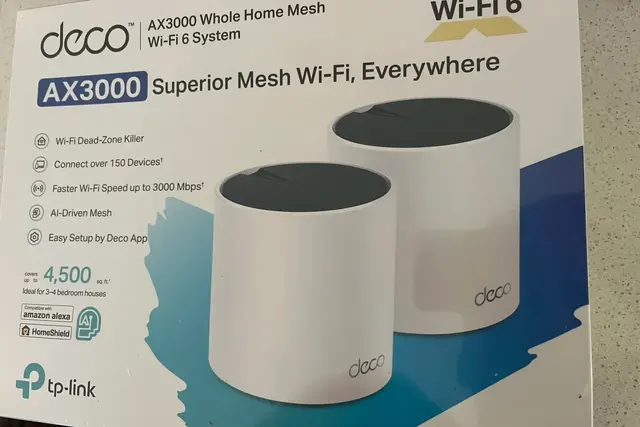
The source account concerns a TP-Link Deco X55 mesh system used in the United States; the official US product page identifies the Deco X55 as a dual-band AX3000 Wi-Fi 6 system. The account does not provide the hardware version or pack size, so its six-day result applies to the author's setup, not every X55 configuration.
| Model in this review | Related regional model | What to know |
|---|---|---|
| TP-Link Deco X55 | TP-Link Deco X55 (United States) | The official US Deco X55 page matches the product named in the account. It specifies three Gigabit WAN/LAN auto-sensing ports per unit and optional Ethernet backhaul; hardware version, pack size and regional firmware need separate checking, so the account does not establish that every configuration behaves the same way. |
- Model in this review
- TP-Link Deco X55
- Related regional model
- TP-Link Deco X55 (United States)
- What to know
- The official US Deco X55 page matches the product named in the account. It specifies three Gigabit WAN/LAN auto-sensing ports per unit and optional Ethernet backhaul; hardware version, pack size and regional firmware need separate checking, so the account does not establish that every configuration behaves the same way.
What the six-day follow-up establishes
The DNS-like interruptions stopped being observed for six days after the author changed the Deco X55 to access-point mode and restored an older Almond router as the front router. That sequence makes the Deco routing role a plausible suspect in this particular setup, but it does not identify the cause or prove that access-point mode will resolve similar faults elsewhere.
The interruptions affected both wired and wireless computers, while several televisions continued streaming live broadcasts; one wired computer also failed while another using a VPN worked. These mixed results do not establish whether the fault was DNS, the internet connection, or another part of the network.
Features and configuration to check
The US Deco X55 is a dual-band AX3000 Wi-Fi 6 mesh system with three Gigabit WAN/LAN auto-sensing ports per unit and optional Ethernet backhaul. These are manufacturer-listed features, not findings from the author's troubleshooting; the source account does not test wireless speed, coverage, or wired backhaul.
Check the hardware version, pack size and regional firmware for the specific Deco X55 before applying this account to a purchase or setup. The official product information says those details must be checked separately, and the source does not identify them for the author's system.
Troubleshooting takeaways from this setup
A reset and a DNS-server change did not provide a lasting fix in this case: resetting the Decos helped for one day, while changing DNS servers did not help. The later six-day period without a recurrence followed a change in the network's router arrangement, but the account does not establish which change mattered or whether the issue was permanently resolved.
The reported pauses cleared within ten minutes and could be followed by hours of normal operation, so the six-day follow-up is a useful short-term observation rather than a long-term reliability result. The author does not report a confirmed diagnosis or a longer monitoring period.
Related Reading
Reviews & Guides · Computing & Networking
TP-Link Deco X55 in a two-storey Australian home: Wi-Fi across 300 m²
I installed two TP-Link Deco X55 units in my 300 m², two-storey home; bedrooms that often lost Wi-Fi now had a signal throughout the house.
Reviews & Guides · Computing & Networking
TP-Link Deco X55 after nearly a year: six units, Teams and gaming
I’ve used six TP-Link Deco X55 units for nearly a year, including daily Teams calls and online gaming; I’ve had only one or two connectivity issues.
Reviews & Guides · Computing & Networking
TP-Link Deco X55 with wired backhaul: less buffering and steadier calls
I connected three Deco X55 units by Ethernet behind my Gen 2 Starlink router. I noticed less buffering, no more dropped Zoom calls and generally better speeds.