
Reviews & Guides · Computing & Networking
TP-Link Deco X55 with wired backhaul: less buffering and steadier calls
Reviewed: TP-Link Deco X55, Starlink Gen 2 RouterRegional reference: TP-Link Deco X55 (United States)
I connected three Deco X55 units by Ethernet behind my Gen 2 Starlink router. I noticed less buffering, no more dropped Zoom calls and generally better speeds.
I have been happy with my Deco X55 system. My Gen 2 Starlink router is in bypass mode and connects through its Ethernet adapter to the main X55. The other two X55 units also connect to the main one by Ethernet.
That gives me wired connections for fixed devices such as the TV, Xbox, Fire Stick and PC, while the rest of the house uses Wi-Fi.
Compared with using two Gen 2 Starlink routers as a mesh, I get much less buffering, no more dropped Zoom calls and generally better speeds.
Source: baskinginthesunbear · Reddit · 2025-05-18 · Help extending network range — baskinginthesunbear’s reply. Original post
Before You Buy
Models in your region
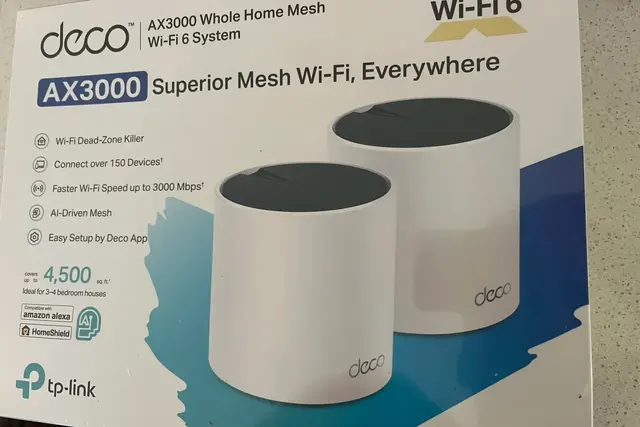
The owner used a TP-Link Deco X55 system with a Gen 2 Starlink router; the comparison is with two Gen 2 Starlink routers used as a mesh. TP-Link’s US Deco X55 is a dual-band AX3000 Wi-Fi 6 mesh system with three Gigabit WAN/LAN auto-sensing ports per unit and optional Ethernet backhaul. The account does not specify the X55 hardware version, so check the version and regional firmware for the unit you are considering.
| Model in this review | Related regional model | What to know |
|---|---|---|
| TP-Link Deco X55 | TP-Link Deco X55 (United States) | The US Deco X55 is a dual-band AX3000 Wi-Fi 6 mesh system with three Gigabit WAN/LAN auto-sensing ports per unit and optional Ethernet backhaul. The owner’s account does not identify the hardware version or firmware, so confirm those for your market. |
- Model in this review
- TP-Link Deco X55
- Related regional model
- TP-Link Deco X55 (United States)
- What to know
- The US Deco X55 is a dual-band AX3000 Wi-Fi 6 mesh system with three Gigabit WAN/LAN auto-sensing ports per unit and optional Ethernet backhaul. The owner’s account does not identify the hardware version or firmware, so confirm those for your market.
Wired backhaul and fixed devices
The US Deco X55 supports optional Ethernet backhaul, which can link mesh units by cable rather than relying on a wireless connection between them. The owner connected both additional units to the main X55 by Ethernet and used wired connections for fixed devices, leaving Wi-Fi for the rest of the house. The account does not establish that this arrangement will produce the same results in other homes.
Each US Deco X55 unit has three Gigabit WAN/LAN auto-sensing ports. That provides wired-port options for a setup like the owner’s, but the account does not specify which device used which port or how many ports remained free.
What the reported improvement does—and does not—show
The owner preferred the three-unit Deco X55 setup over using two Gen 2 Starlink routers as a mesh, reporting much less buffering, no more dropped Zoom calls and generally better speeds. These are the owner’s observations, not measured throughput results; no speed figures or test conditions were supplied, so the size of any performance gain cannot be quantified.
Check the exact X55 version for your market
TP-Link notes that pack size, hardware version and regional firmware must be checked separately. Confirm the specifications and firmware for the version sold in your market before applying this setup experience to a purchase; the owner’s post does not identify those details. The official US listing describes the X55 as dual-band AX3000 Wi-Fi 6, and the X55 Pro is a distinct product.
Coverage and throughput depend on layout, building materials, unit placement, client devices and backhaul. The owner’s reported improvement is therefore useful as one household’s experience, not a guarantee for a different floor plan or connection.
Related Reading
Reviews & Guides · Computing & Networking
TP-Link Deco X55 in a two-storey Australian home: Wi-Fi across 300 m²
I installed two TP-Link Deco X55 units in my 300 m², two-storey home; bedrooms that often lost Wi-Fi now had a signal throughout the house.
Reviews & Guides · Computing & Networking
TP-Link Deco X55: DNS pauses stopped for six days in access-point mode
I switched my Deco X55 to access-point mode and restored my older router to the front of the network. The DNS-like pauses stayed away for six days.
Reviews & Guides · Computing & Networking
TP-Link Deco X55 after nearly a year: six units, Teams and gaming
I’ve used six TP-Link Deco X55 units for nearly a year, including daily Teams calls and online gaming; I’ve had only one or two connectivity issues.