
Reviews & Guides · Kitchen & Dining
De’Longhi ECO310: 15 g doses, wet pucks and daily cleaning
Reviewed: De'Longhi ECO310Regional reference: Icona ECO-310.BK (US)
I use 15 g in my De’Longhi 310, not the usual 18 g recipe. I explain what I do about fast flow, wet pucks, dripping and cleaning.
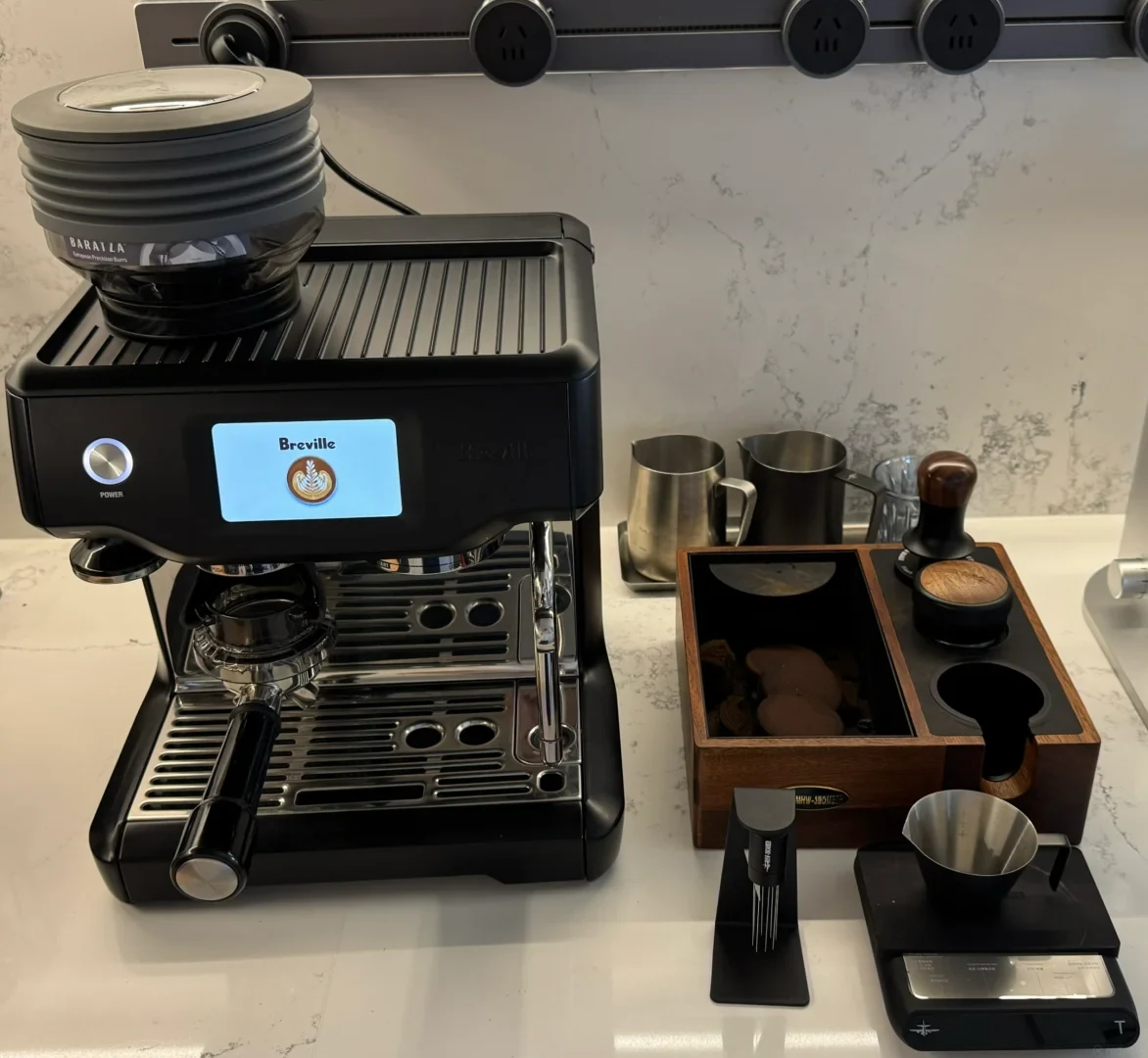
An experienced De’Longhi 310 user answers common questions.
Here are answers to ten common questions about getting started with the De’Longhi 310.
The operating videos in my profile collection may help you get even more from this guide.
An experienced user answers common questions: ten De’Longhi 310 issues and practical tips.
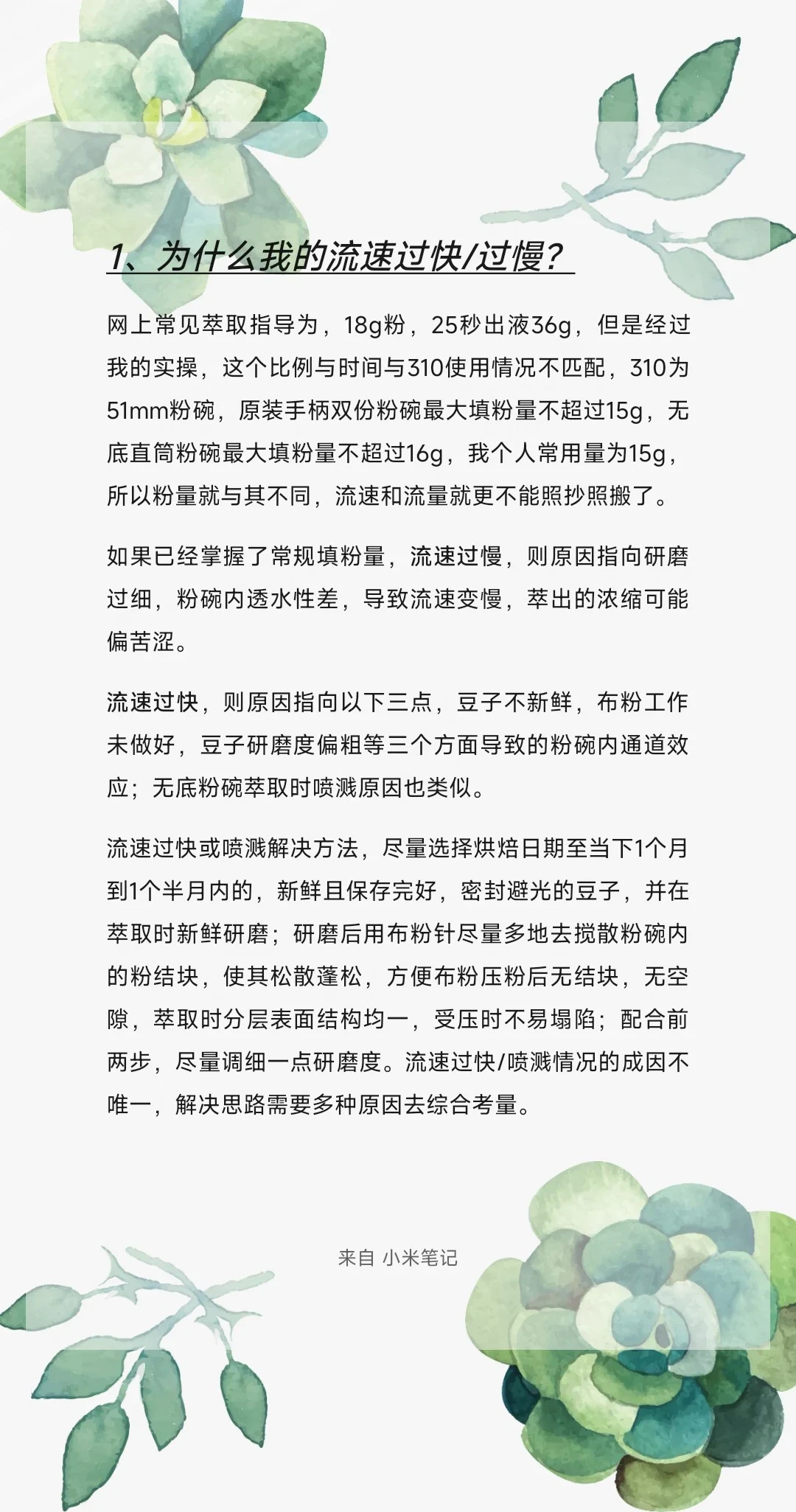
1. Why is my espresso flowing too fast or too slowly?
The common extraction guide online calls for 18 g of coffee, a 25-second extraction and 36 g of espresso. In my experience, that recipe and timing do not suit the 310. Its 51 mm basket holds no more than 15 g in the original double basket, or 16 g in a straight-sided bottomless basket. I usually use 15 g, so the dose is different—and the flow rate and output cannot simply be copied from that recipe.
Once you have a consistent dose, slow flow points to a grind that is too fine and poor water permeability in the basket. The espresso may then taste bitter or harsh.
Fast flow can have three causes: stale beans, poor distribution, or a grind that is too coarse. These can cause channeling in the basket. The causes of spraying during a bottomless-portafilter shot are similar.
To address fast flow or spraying, choose fresh, well-stored beans—ideally roasted within the past month to six weeks—and grind them just before brewing. After grinding, use a distribution needle to break up as many clumps as possible so the grounds are loose and even. That helps avoid clumps and gaps after distribution and tamping, and makes the surface less likely to collapse under pressure. Along with those steps, try grinding a little finer. Fast flow and spraying can have more than one cause, so consider the possible causes together.
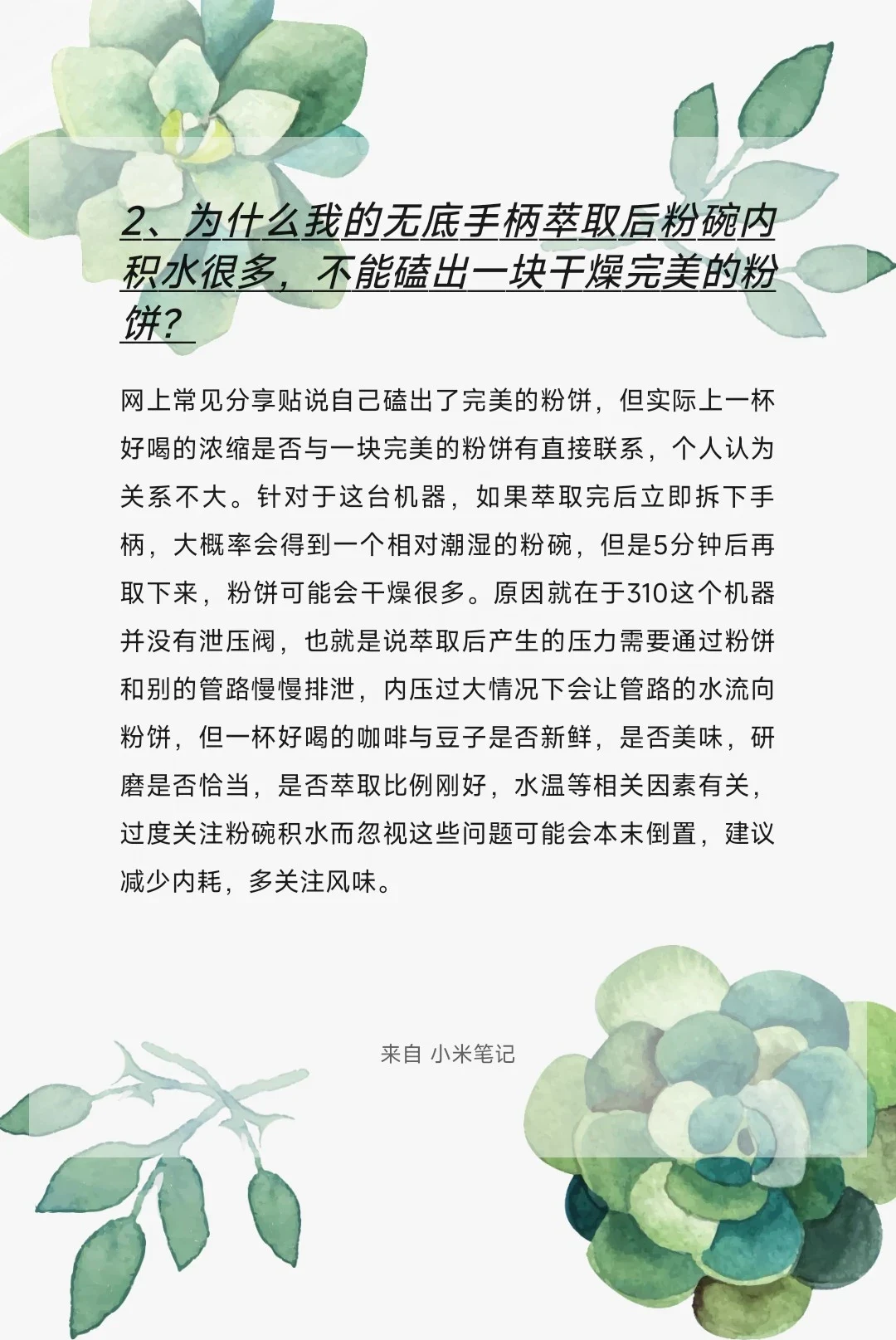
2. Why is there so much water in my bottomless portafilter after brewing, instead of a dry, neat puck?
Online posts often show people knocking out a perfect puck, but I do not think a perfect puck has much to do with whether the espresso tastes good. With this machine, removing the portafilter immediately after brewing will probably leave the grounds fairly wet; wait five minutes and the puck may be much drier. In my view, the 310 has no pressure-release valve, so pressure after brewing escapes gradually through the puck and other plumbing. When the internal pressure is high, water can be pushed through the plumbing toward the puck. But good espresso depends on factors such as bean freshness and flavor, grind, brew ratio and water temperature. Focusing too much on water in the basket while overlooking those factors can distract from what matters. I suggest worrying less about the puck and paying more attention to flavor.
3. Why does my coffee always taste bitter?
There are many kinds of coffee beans on the market, with different brands and roast levels, from very light through light, medium-light, medium, medium-dark, dark and very dark. Their flavor profiles vary. Broadly speaking, lighter roasts tend to have more fruity acidity and less caramel-like bitterness, while darker roasts tend to have less acidity and more caramel and chocolate notes. This is related to the Maillard reaction during roasting: as the roast gets darker, those reactions become more pronounced, the beans take on more roasted, browned character, and acidity gives way to caramel, chocolate and other mature-roast flavors. If every cup tastes bitter, first consider the beans. If a bag says it is 100% Arabica, bitterness may come more from the roast level or preparation—for example, grinding too fine or not flushing water before brewing, which can leave overheated water in the pipe and strip away too much of the beans’ flavor. If the beans do not state their variety and taste bitter, rubbery and astringent, I suggest avoiding them; they may contain inexpensive Robusta.
4. The light goes out less than 10 seconds after I lock in the portafilter and press the brew button. Is the machine broken?
First, the machine is not broken. The 310 is an entry-level, single-pump machine with a thermoblock. Hot water travels from the tank to the brew head through a heated path. It heats quickly, but the available water is limited and the internal pipes can get too hot. When the brew light comes on, I usually pulse water through the brew head several times before locking in the portafilter, stopping when the water no longer comes out with visible overheating vapor. The temperature may then be relatively stable, but I cannot ensure it stays as constant as a boiler machine’s; it can drop more toward the end of brewing. I suggest keeping the 310’s espresso output modest: with 15 g of grounds, I aim for no more than 25 g of espresso.
5. Water drips from the steam wand while the machine heats or brews. Is it broken?
The machine is not broken; this is normal. As noted above, the 310 has a single pump and a thermoblock. The pump can handle only one task at a time—brewing or steaming milk—and the machine has no pressure-release device. In my observation, the steam wand drips while doing something like the work of a boiler machine’s pressure-release valve. There is no need to worry: put a cup underneath to catch the water, and clear the condensed water before steaming milk.
6. The portafilter keeps dripping after brewing. Is the machine broken?
The machine is not broken; this is normal. After I switch off brewing, the pressure inside the machine remains relatively high. The steam wand releases some of it, while the puck also bears some of the pressure. Water left in the pipes is pushed onto the puck and slowly seeps out. You do not need the final drips of espresso: move your cup away and use another cup to catch the remaining liquid.
7. Videos of making coffee use so many tools. Which should I prioritize?
Highest priority—must-haves: a digital scale, a distribution needle and a coffee distributor.
Medium priority—good to have, but not essential: a dosing ring or cup, a bottomless portafilter, a distribution tamper and portafilter filter paper.
Lowest priority—optional extras that are more about enjoyment: a bean-weighing dish, silicone mat and similar items.
8. Do I have to get a bottomless portafilter?
Not necessarily. A bottomless portafilter makes it easier to watch each extraction. I feel its main value is helping you understand grind and distribution technique so you can make a decent espresso; if the shot sprays or flows unevenly, you can adjust next time. A regular bottomless portafilter does not offer a substantial improvement on the 310. A better machine may show different flavor results with different baskets and flow rates, but I do not think that applies to the 310. Focus on getting your everyday extraction right.
9. How should I clean the 310?
I put filter paper in the portafilter for each extraction to help keep the brew head clean. After brewing, I run water through the brew head to flush out coffee grounds, remove and rinse the drip tray to clear out coffee and standing water, and let it dry. I wipe the brew head in a circular motion with a damp cloth.
I recommend giving the water tank a thorough clean every one to two weeks. Biofilm can develop more easily in hot weather, so scrub it well. If possible, use water from a reverse-osmosis purifier.
The inside of the brew head does not need frequent cleaning. If you make two or three cups a day, I suggest taking it apart about every six months. Remove the water tank and wipe away leftover water, then unscrew the shower screen and wipe off the coffee grounds.
10. How do I choose the best type of coffee machine?
This question bothered me for a long time, but I eventually realized that the answer is different for everyone.
The key question is what kind of coffee you want.
If you have to get up early for work and just want a functional hit of caffeine, the complicated process and cleanup of a semi-automatic espresso machine may frustrate you. When work is already draining, ten more minutes of sleep may sound better than getting up early to wash two extra cups. If you do not need anything more, I suggest buying coffee from a chain café; the fully automatic machines used by that coffee chain are very expensive.
If you dislike the taste of coffee bought outside but want to make it at home without much work, I might recommend a capsule machine. It offers a range of bean flavors, consistent results and a cup in three minutes, and you can customize it: add milk for a latte, water for an Americano, or juice for a flavored Americano. There is no cleanup either.
If you want to make coffee by hand and are willing to put in the time, patience and persistence, I might recommend a dual-boiler, rotary-pump espresso machine. If you have a budget of 5,000 yuan, I suggest spending 4,000 yuan on the machine and 1,000 yuan on the grinder for a better experience. If money is tight, try to choose a dual-pump machine with a brew boiler so you can brew and steam milk at the same time. If your budget is under 2,000 yuan, I suggest buying a capsule machine instead; otherwise, you may have a more frustrating experience.
Source: 是魔鱼啊 · Xiaohongshu · 2025-05-22 · 新手必看!德龙310最常见10个问题全解答!. Search this Chinese title in Xiaohongshu to find the original post.
Before You Buy
Models in your region
The FAQ combines the author’s own 15 g recipe with explanations of flow, wet pucks, dripping and cleaning. Several hardware explanations are the author’s interpretation; the US Icona ECO-310.BK below is a regional reference with different supplied-filter dosing guidance.
| Model in this review | Related regional model | What to know |
|---|---|---|
| De’Longhi ECO310 (source unit; regional suffix unspecified) | Icona ECO-310.BK (US) | The US version lists a manual frother, a filter holder for ground coffee or E.S.E. pods, a stainless-steel boiler and dual thermostats. The source unit’s complete suffix and replacement baskets are not identified; check the local rating and manual. |
- Model in this review
- De’Longhi ECO310 (source unit; regional suffix unspecified)
- Related regional model
- Icona ECO-310.BK (US)
- What to know
- The US version lists a manual frother, a filter holder for ground coffee or E.S.E. pods, a stainless-steel boiler and dual thermostats. The source unit’s complete suffix and replacement baskets are not identified; check the local rating and manual.
The boiler specification and the author’s explanation
De’Longhi lists a stainless-steel boiler and dual thermostats for the US Icona ECO-310.BK. The FAQ instead calls the author’s machine a thermoblock design; it does not identify a complete suffix or document an internal inspection. Its explanation of pressure-release plumbing is also unverified, so use the official documentation for the exact unit when identifying the heating system or a fault.
The US ECO310 manual lists 120 V, 60 Hz and 1100 W. That rating applies to the North American reference; the source machine’s electrical rating is unknown, so verify the rating plate on the actual unit before connecting it to local power.
Dose and tamp for the supplied baskets
The US manual gives approximate doses of 7 g for its small, single-coffee filter and 12 g for its larger, two-cup filter. It advises distributing grounds evenly and tamping lightly; its troubleshooting guidance links overly slow flow with pressing too hard and fast flow with pressing too lightly. These instructions cover the regional supplied filters, not the author’s 15 g recipe or replacement 51 mm baskets, so do not assume those doses transfer unchanged.
For the source unit, the author uses 15 g and suggests no more than 25 g of espresso, while treating fresh beans, distribution and grind as possible contributors to fast flow or spraying. This is personal guidance for that unit and setup, not a universal ECO310 specification or a verified diagnosis of another machine.
Use the steam wand and portafilter with care
The regional manual says to prepare coffee before milk when making several cappuccinos, allow the boiler to cool before switching from steam back to brewing, and wash the frother after use. It also warns against touching hot surfaces and advises using handles and knobs. Follow the instructions supplied for the exact local model; the manual does not establish that third-party modifications are approved.
The author attributes wand drips and post-brew portafilter drips on the source unit to pressure and residual water, but the available US manual does not confirm that explanation or establish that persistent wand leakage during brewing is normal. If dripping is persistent or unusual on your unit, this account alone cannot determine its cause; consult the local manual or De’Longhi support rather than treating the explanation as a verified fault diagnosis.
Clean the frother and brew path as directed
The US manual says to switch off, unplug and cool the machine before cleaning external parts, and to clean the frother after use. It describes cleaning the filters and boiler outlet about every 300 coffees, with the boiler-outlet procedure starting only after the machine is cool and disconnected from the mains. These instructions are for the US regional reference; use the care instructions supplied with your local model.
For the source unit, the author’s routine is to flush and wipe the brew head, rinse and dry the drip tray, and clean the water tank every one to two weeks. The author suggests cleaning the internal screen about every six months when making two or three cups daily. These are personal intervals, not the US manual’s stated schedule; the manual instead gives a filter and boiler-outlet interval of about 300 coffees.
Related Reading
Reviews & Guides · Kitchen & Dining
De’Longhi ECO310 after two weeks: richer coffee, more cleanup
I found the De’Longhi ECO310 made coffee that tasted fuller than my pour-over, but its more involved routine and cleanup didn’t suit my fast mornings.
Reviews & Guides · Kitchen & Dining
De’Longhi ECO310: a leaking first unit and a working replacement
My first De’Longhi ECO310 leaked when I switched it on. The seller sent a replacement that worked normally, completing my move from a moka pot.
Reviews & Guides · Kitchen & Dining
De’Longhi ECO310 after a year: cleaning and using it more often
I now flush the De’Longhi ECO310 before and after brewing, then wipe and brush it; after more than a year, I’ve had no handle ejections.