
Reviews & Guides · Computing & Networking
HUAWEI Lingxiao Q7 Powerline Edition: 621 Mbps in the far bedroom
Reviewed: HUAWEI Lingxiao Q7 Powerline EditionRegional reference: HUAWEI Lingxiao Q7 Powerline Edition (China); HUAWEI WiFi Mesh 3 (UK)
I measured 621 Mbps in the far bedroom with the HUAWEI Lingxiao Q7 Powerline Edition, compared with 187 Mbps from the main router alone.
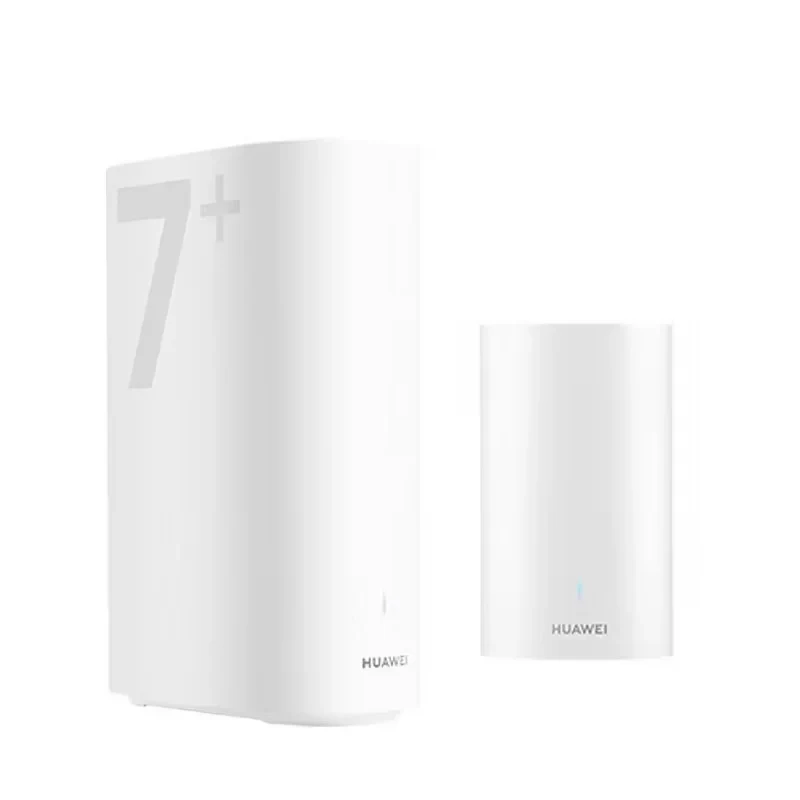
First, the test setup. The measured floor area was 118 m², with three load-bearing walls, three bedrooms, two living rooms, one kitchen and two bathrooms. The broadband plan was 1,000 Mbps; the optical network terminal was set to bridge mode, and the main router handled PPPoE dial-in. I placed the main router on the living-room TV cabinet, then moved the child node in turn to the main bedroom, second bedroom, study and the bathroom entrance. I used the same phone within the same test period and averaged three readings at each location.
Near the router in the living room, the results were 941 Mbps down, 96 Mbps up and 3 ms latency. The dining room measured 876 Mbps down and 4 ms latency. With the door closed, the main bedroom reached 812 Mbps down and 5 ms latency. The middle of the corridor measured 734 Mbps down, the far corner of the second bedroom 621 Mbps, and the bathroom 583 Mbps.
For comparison, using only the main router at the same spot, the far corner of the second bedroom reached just 187 Mbps, and video loading showed a spinning indicator. After I plugged in the child node, the speed rose to 621 Mbps. The improvement was very noticeable.
Mesh networking, powerline networking, broadband speed improvement, HUAWEI Q7, router testing, #WildReviewerHowto.
Source: 农村喂鸡被鸡踹飞两百米 · Xiaohongshu · 2026-09-21 · 老房救星:Q7电线版十四天使用报告. Search this Chinese title in Xiaohongshu to find the original post.
Before You Buy
Models in your region
The tested product is identified as the HUAWEI Lingxiao Q7 Powerline Edition, but the exact kit configuration, phone, firmware and electrical-circuit conditions are not given. The UK HUAWEI WiFi Mesh 3 is a related whole-home system, not a regional rename of the Q7 Powerline Edition; the Q7’s room-speed results do not establish Mesh 3 performance.
| Model in this review | Related regional model | What to know |
|---|---|---|
| HUAWEI Lingxiao Q7 Powerline Edition | HUAWEI Lingxiao Q7 Powerline Edition (China) | The Chinese product named in the account is the Q7 Powerline Edition. HUAWEI specifies a hybrid powerline-and-Wi-Fi mesh system; its lab networking figure of up to 1.5 Gbps is not the same as the author’s measured internet speeds. |
| HUAWEI Lingxiao Q7 Powerline Edition | HUAWEI WiFi Mesh 3 (UK) | This UK model is a different Wi-Fi 6 mesh system, not the Q7’s regional counterpart. It has no powerline specification in the supplied evidence, so the Q7’s powerline-assisted room results should not be applied to it. |
- Model in this review
- HUAWEI Lingxiao Q7 Powerline Edition
- Related regional model
- HUAWEI Lingxiao Q7 Powerline Edition (China)
- What to know
- The Chinese product named in the account is the Q7 Powerline Edition. HUAWEI specifies a hybrid powerline-and-Wi-Fi mesh system; its lab networking figure of up to 1.5 Gbps is not the same as the author’s measured internet speeds.
- Model in this review
- HUAWEI Lingxiao Q7 Powerline Edition
- Related regional model
- HUAWEI WiFi Mesh 3 (UK)
- What to know
- This UK model is a different Wi-Fi 6 mesh system, not the Q7’s regional counterpart. It has no powerline specification in the supplied evidence, so the Q7’s powerline-assisted room results should not be applied to it.
What the Q7’s room-speed results show
The Q7 Powerline Edition’s child node coincided with a higher measured speed in the far corner of the second bedroom: 621 Mbps versus 187 Mbps from the main router alone at the same location. That comparison comes from this 118 m² home, the same phone and three averaged readings per spot; it does not establish results for other homes or circuits.
The latency readings were 3 ms near the router in the living room, 4 ms in the dining room and 5 ms in the main bedroom with its door closed. Upload was reported only in the living room, at 96 Mbps. No latency figures were given for the corridor, far second-bedroom corner or bathroom. The source calls this a fourteen-day use report, but provides no continuous uptime log or raw speed-test captures.
Q7 Powerline Edition features and setup
The China-market Q7 Powerline Edition combines dual-band Wi-Fi 7 with third-generation Lingxiao powerline networking and Wi-Fi Mesh hybrid backhaul. HUAWEI lists theoretical rates of 688 Mbps on 2.4 GHz and 2,882 Mbps on 5 GHz, and lab networking up to 1.5 Gbps; these are manufacturer specifications, not the measured internet speeds in the home report.
Check the port layout if you need wired connections: the parent unit has one 2.5GbE port and two 1GbE ports, while each child unit has one 1GbE port. HUAWEI says bundled nodes are plug-and-play, but separately purchased nodes need initial setup; the account does not identify its exact kit, so its setup experience cannot confirm how an add-on node would behave.
How the UK WiFi Mesh 3 differs
The UK HUAWEI WiFi Mesh 3 uses dual-band Wi-Fi 6, with theoretical rates of 574 Mbps and 2,402 Mbps, and has three 1GbE auto-WAN/LAN ports. It is a separate mesh product rather than a renamed Q7 Powerline Edition, and the supplied evidence does not establish powerline backhaul or cross-model interoperability; buyers should not assume the Q7 test results apply.
Related Reading
Reviews & Guides · Computing & Networking
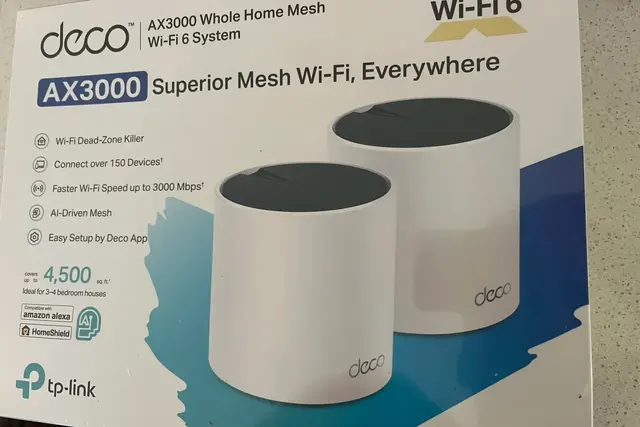
TP-Link Deco X55 in a two-storey Australian home: Wi-Fi across 300 m²
I installed two TP-Link Deco X55 units in my 300 m², two-storey home; bedrooms that often lost Wi-Fi now had a signal throughout the house.
Reviews & Guides · Computing & Networking
TP-Link Deco X55: DNS pauses stopped for six days in access-point mode
I switched my Deco X55 to access-point mode and restored my older router to the front of the network. The DNS-like pauses stayed away for six days.
Reviews & Guides · Computing & Networking
TP-Link Deco X55 after nearly a year: six units, Teams and gaming
I’ve used six TP-Link Deco X55 units for nearly a year, including daily Teams calls and online gaming; I’ve had only one or two connectivity issues.