
Reviews & Guides · Kitchen & Dining
MAVO Wizard Z Pro vs Phantox Pro: easier adjustment and cleaning
Reviewed: MAVO Wizard Z Pro, MAVO Phantox ProRegional reference: MAVO Wizard Z Pro (United States / international store); MAVO Phantox Pro (United States / international store)
I compared the MAVO Wizard Z Pro and Phantox Pro: their weights are close, but the Z Pro’s stepless adjustment and tool-free burr removal stood out.






I recently picked up MAVO’s new Wizard Z Pro for this year.
I also had a Phantox Pro on hand, so I put the two grinders side by side for a simple comparison of their appearance, weight, adjustment, burr construction, and disassembly and maintenance.
Both are hand grinders covering pour-over through espresso, but after comparing them, I found several Wizard Z Pro improvements worth noting.
Appearance and build:
Both have metal bodies and feel well made overall.
The Wizard Z Pro has a noticeably cleaner design, especially the purple accent below the adjustment ring, which makes it more distinctive. By comparison, the Phantox Pro looks more traditional.
In hand, even though the Wizard Z Pro costs about half as much as the Phantox Pro, its build and feel did not seem noticeably inferior to me.
- Weight comparison:
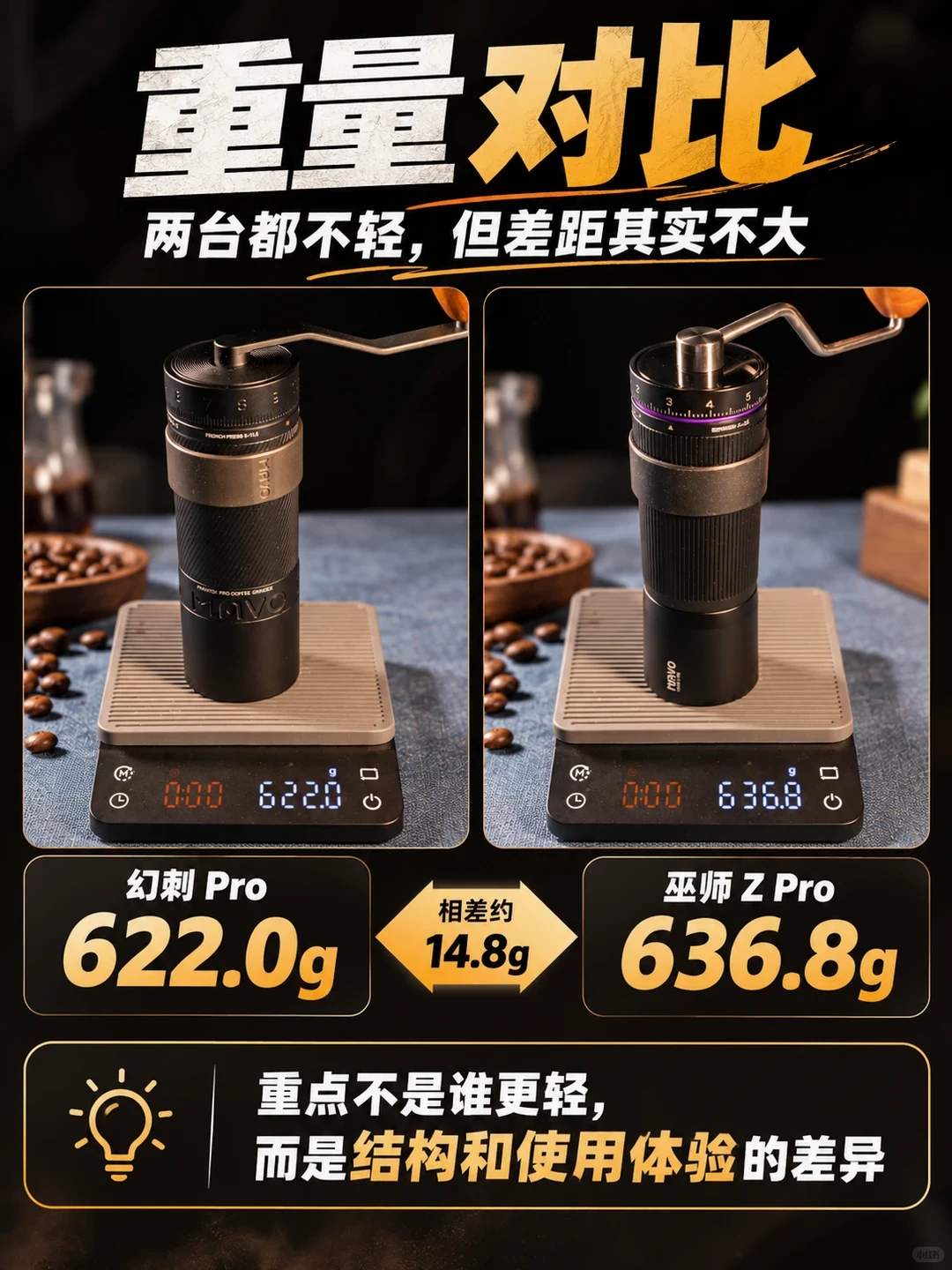
Measured weights
Phantox Pro: 622 g
Wizard Z Pro: 636.8 g
The difference is only about 14.8 g, so in actual use I don’t think the weight makes a noticeable difference.
3. Adjustment:
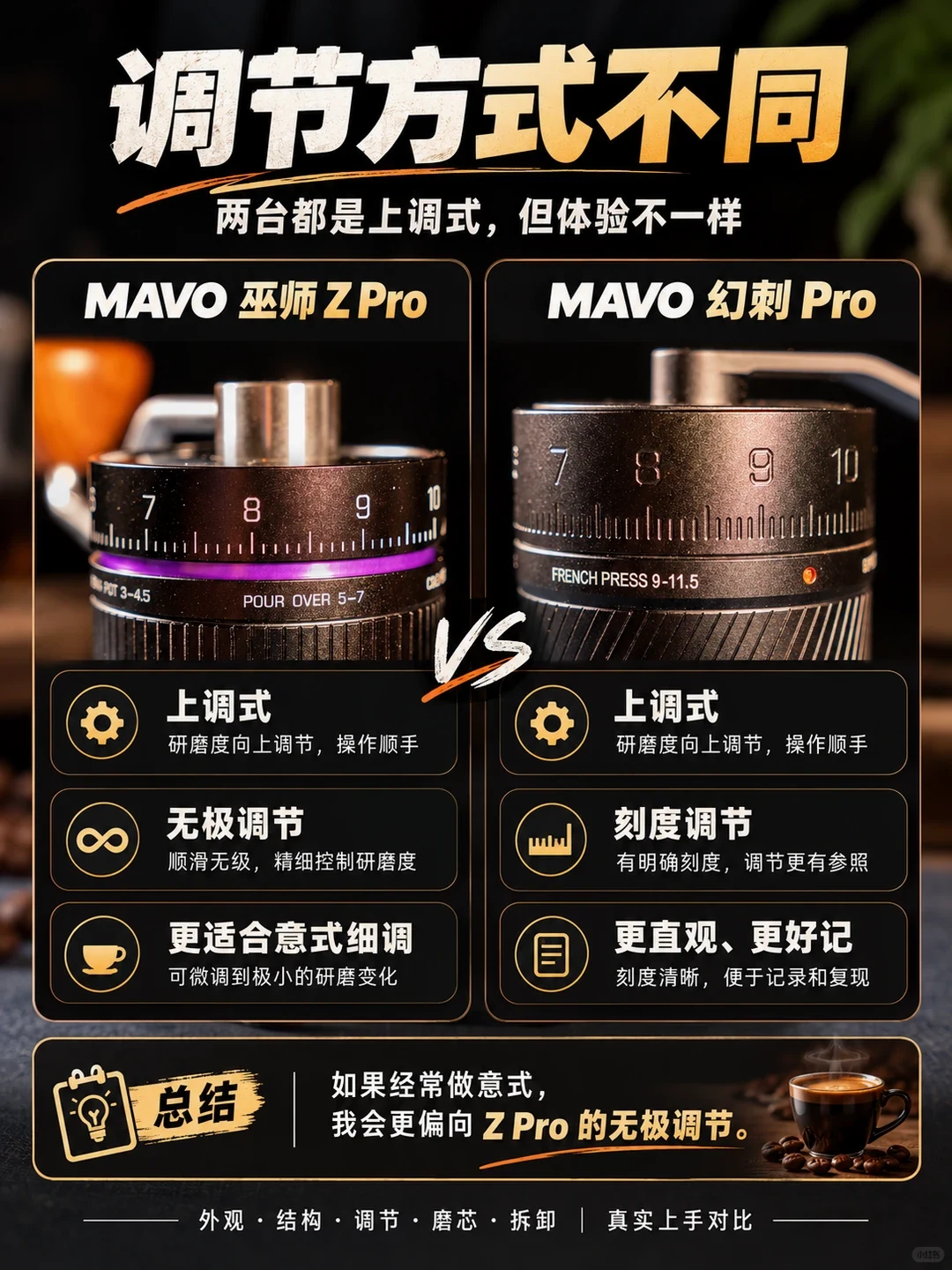
Both adjust from the top, but they use different methods
Phantox Pro: stepped adjustment.
Wizard Z Pro: stepless adjustment.
I prefer the Wizard Z Pro’s stepless adjustment. It gives me more freedom, especially when I want to make fine grind-size changes for espresso.
4. Burr and cutting-edge design:
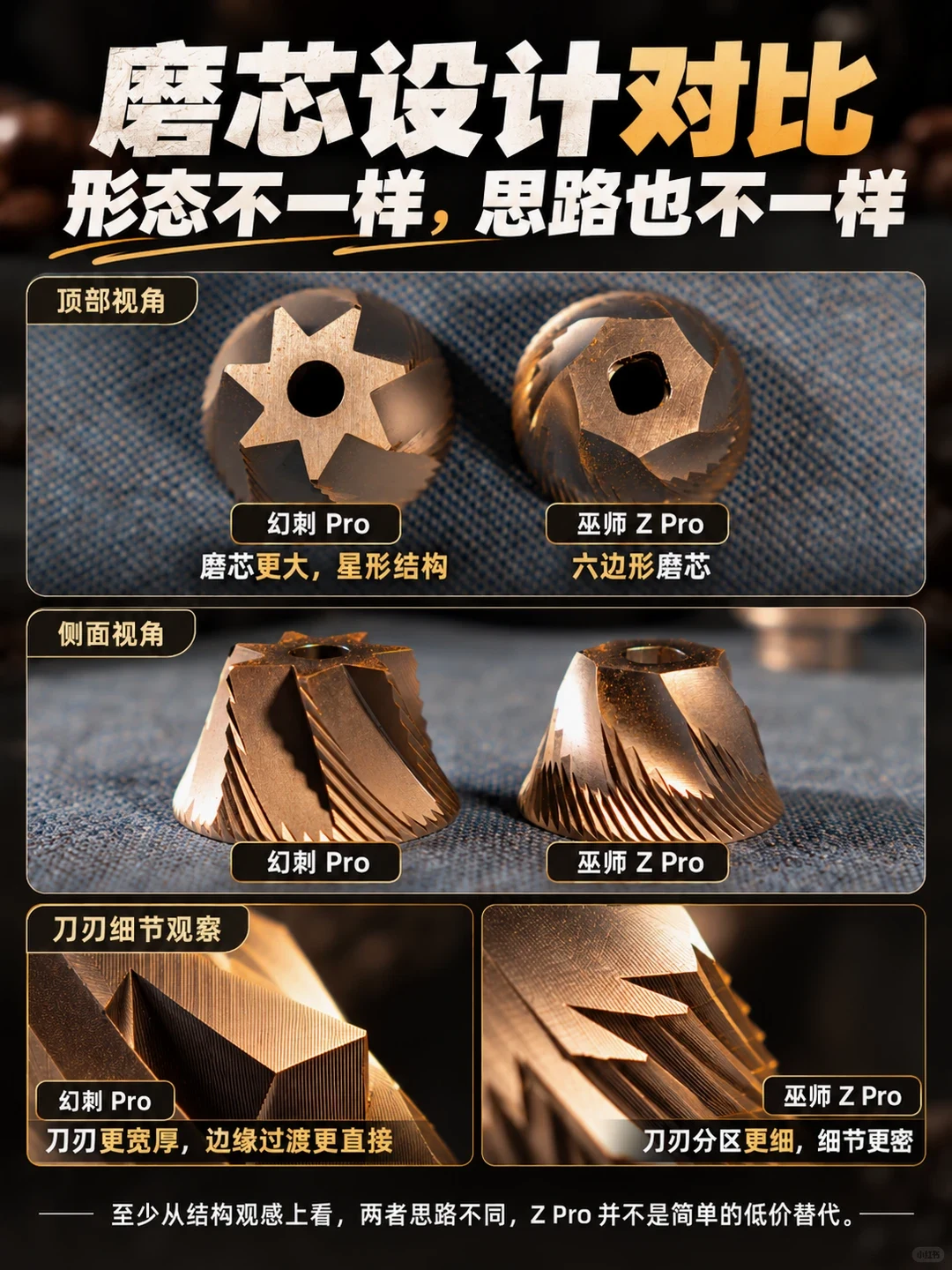
The two burrs have noticeably different geometries
Phantox Pro: a larger, star-shaped burr.
Wizard Z Pro: a hexagonal burr.
Their cutting-edge details and internal structures also reflect different design approaches.
The Phantox Pro has crossed blades inside, while the Wizard Z Pro uses a more conventional inner-blade design.
It’s difficult to tell which one grinds better just from its structure and appearance; actual grinding and brewing experience would also matter.
5. Disassembly and maintenance:
This is where I think the Wizard Z Pro has made one of its more noticeable improvements.
Removing the Phantox Pro’s burr requires a hex tool, while the Wizard Z Pro can be disassembled without tools.
That makes the Wizard Z Pro considerably more convenient if you clean your grinder often or like taking it apart to explore how it works.
A few thoughts on brewing
So far, I’ve only tried the Wizard Z Pro with one light-roast Gesha for a pour-over.
The cup was good overall, but compared with the Phantox Pro, I felt the Wizard Z Pro had just a little more bitterness and off-flavors.
Of course, I’ve tested only a limited number of beans and brews, so I can’t use this to judge the grinders’ overall flavor differences.
My interim take
The Wizard Z Pro is not simply the Phantox Pro with a different look.
From stepless adjustment and tool-free disassembly to its overall appearance, it brings several changes to the user experience.
The Phantox Pro made more of an impression on me with its burr structure, while the Wizard Z Pro is more appealing for everyday operation and maintenance.
Source: DummiesCoffee呆萌咖啡 · Xiaohongshu · 2026-10-31 · MAVO巫师ZPro vs 幻刺Pro 两款手磨差在哪?. Search this Chinese title in Xiaohongshu to find the original post.
Before You Buy
Models in your region
MAVO lists the Wizard Z Pro and Phantox Pro as separate models in its US/international store. The comparison below concerns the two grinders used by the author; the official specifications help clarify listed features, but do not establish the results of the author’s limited brewing comparison.
| Model in this review | Related regional model | What to know |
|---|---|---|
| MAVO Wizard Z Pro | MAVO Wizard Z Pro (United States / international store) | A separate model from the Phantox Pro, with manufacturer-listed stepless external adjustment, a 43 mm Lumiblade burr, and quick-release burr assembly for dry cleaning. The author’s weight and single-brew observations apply to their Wizard Z Pro unit. |
| MAVO Phantox Pro | MAVO Phantox Pro (United States / international store) | A separate model with a manufacturer-listed 45 mm Starblade burr and external adjustment ring with 120 clicks per revolution. The author’s 622 g measurement and comparison brew apply to their Phantox Pro unit. |
- Model in this review
- MAVO Wizard Z Pro
- Related regional model
- MAVO Wizard Z Pro (United States / international store)
- What to know
- A separate model from the Phantox Pro, with manufacturer-listed stepless external adjustment, a 43 mm Lumiblade burr, and quick-release burr assembly for dry cleaning. The author’s weight and single-brew observations apply to their Wizard Z Pro unit.
- Model in this review
- MAVO Phantox Pro
- Related regional model
- MAVO Phantox Pro (United States / international store)
- What to know
- A separate model with a manufacturer-listed 45 mm Starblade burr and external adjustment ring with 120 clicks per revolution. The author’s 622 g measurement and comparison brew apply to their Phantox Pro unit.
Choose between stepless and stepped adjustment
The Wizard Z Pro offers stepless external adjustment, while the Phantox Pro’s listed external ring has 120 clicks per revolution. Stepless movement lets you make changes between marked steps; the author particularly liked that flexibility for fine espresso adjustments. The official information does not specify a universal dial setting for a given bean or grinder, so expect to dial in your own coffee rather than rely on a preset.
Burr size and design are not a brew-test result
MAVO lists a 43 mm Lumiblade burr for the Wizard Z Pro and a 45 mm Starblade burr for the Phantox Pro. The author also observed different shapes and internal blade layouts, but noted that appearance alone could not establish which grinder performs better. Their only reported brewing comparison was one light-roast Gesha pour-over; the slightly greater bitterness and off-flavors they perceived in the Wizard Z Pro cup do not establish an overall flavor difference.
Check how each grinder can be cleaned
The Wizard Z Pro’s manufacturer-listed quick-release burr assembly is intended for dry cleaning, matching the author’s observation that this grinder can be opened without tools. The author found the Phantox Pro required a hex tool to remove its burr; MAVO’s care guidance also recommends brushing retained grounds. If you prefer to clean inside the grinder frequently, consider whether tool-free access matters to you.
For the Phantox Pro, MAVO advises brushing away retained grounds and wiping the body with a dry or slightly damp cloth. The manufacturer guidance does not describe an early-batch exchange program, so check directly with the seller or manufacturer if you need to confirm support for a particular unit.
Their measured weights were nearly alike
In this comparison, the Phantox Pro weighed 622 g and the Wizard Z Pro 636.8 g, a difference of about 14.8 g. The author considered that difference negligible in use. These are measurements of the compared units, not manufacturer-listed weights, so they should not be treated as guaranteed weights for every unit.
Related Reading

Reviews & Guides · Kitchen & Dining
Breville Bambino after three and a half years: why I switched to Gaggia Classic E24
After three and a half years, my Bambino seemed to run cooler; I switched to a Gaggia Classic E24 for the beans we buy and roast at home.
Reviews & Guides · Kitchen & Dining
Gaggia Classic E24 daily routine: 18 g in, 36 g out
I make two coffees most mornings with my Gaggia Classic E24, weighing 18 g in and 36 g out. Pairing it with a Sculptor 064S helped me dial in.
Reviews & Guides · Kitchen & Dining
Gaggia Classic E24: 16-second shots and a changed temperature routine
I pulled roughly 26 g shots from 16 g of dark-roast coffee in my Gaggia Classic E24; a new flush routine seemed to slow them slightly, but I did not measure the change.