
Reviews & Guides · Instruments & Audio
Shokz OpenFit Pro: two hours testing noise reduction in the office and on a bike
I used Shokz OpenFit Pro for two hours: office noise reduction was noticeable, but I felt no reduction in wind noise when riding, even at maximum settings.


I wanted to try whether the open-ear headphones’ noise reduction was actually useful.
I tried them in the store, and they seemed fine.
Now I’m riding home to see whether they still work in that situation.
No advertising—this is my own account.
No coordinated cheerleading.
No, I’m going to rant about it.
A note before anyone criticizes
I have used Xiaomi’s open-ear headphones for a long time, including both generations. For noise-cancelling headphones, I have used Sony’s noise-cancelling earbuds and the XM3, so I will compare this experience with Xiaomi’s open-ear headphones and Sony’s noise-cancelling headphones.
All the results are mainly based on my personal experience. I am not trying to disparage any product. If you feel differently, please trust your own experience instead of attacking the products. Respect different opinions.
March 13 — edit 2
Purchase feedback
The store purchase came with the original wireless charger, listed at 199 yuan, and a 430 stainless-steel bottle, which people really seem to like as a gift. There was also a map check-in and positive review promotion offering a choice of swimming goggles, a water bottle, or a waterproof backpack. I chose the backpack because the young store employee said that even if I did not carry it directly, I could put dirty clothes in it and then place it inside my everyday backpack. That successfully convinced me; when I go out to see a concert, I can also put it in my suitcase.
Two-hour headphone-use feedback
Unboxing and case feel
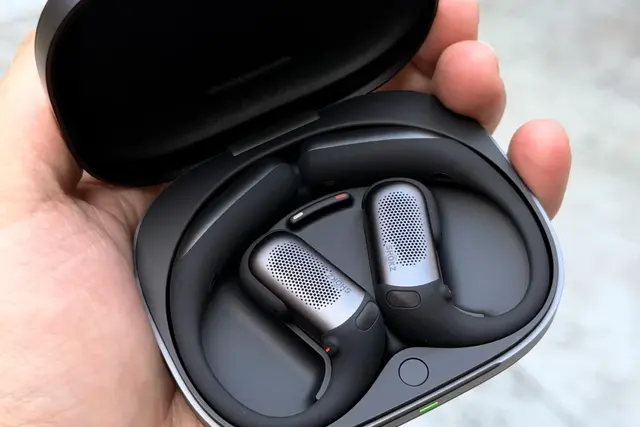
The packaging feels like the best I have seen so far: a black, matte-finish rigid box that looks quite expensive. But if replacing it with an ordinary paper box could lower the price, I would prefer that.
The charging case has more weight than Xiaomi’s, and this model supports wireless charging. That may also be why it is heavier.
Fit, while wearing glasses: I did not feel any obvious pressure where the headphones and glasses compete for space. There was some up-and-down movement, which may simply be unfamiliarity. Putting them on was occasionally awkward, but this did not affect wearing them. Shokz has separately added a soft silicone ear-hook support this time. As for its purpose, I did not feel any practical effect or even notice it, so I cannot say that it provided meaningful support.
Noise filtering, or noise reduction
When I first turned them on, I had not installed the app in the store. I did not notice obvious noise filtering while speaking with the employee or listening to the surrounding environment. The employee said that the app needed to be set up first, so I rode my electric bike home wearing them as they were. With a full-face helmet, the pressure on my right ear was obvious, just as with Xiaomi’s headphones, and I did not feel that the riding wind noise was reduced. After I got home, I downloaded the app and set noise reduction to its maximum level. When I rode again the next morning, I still did not feel that the wind noise had been reduced.
In the office, I could clearly feel noise reduction, although I could still hear people’s voices and their voices sounded higher-pitched. The balance between sound quality and noise reduction did not feel as good as Sony’s noise-cancelling headphones. P.S. The store employee repeatedly confirmed that the headphones could connect to a computer over Bluetooth, but I just tested it and they could not. See Figure 2; the same computer connected to the XM3.
My main reason for buying these headphones was to use noise reduction while avoiding the stuffy, enclosed feeling of wearing over-ear headphones for long periods. My main intended settings are the office and high-speed trains. I will test them tomorrow on the high-speed train to Shanghai, in the quiet carriage.
I will post updates in the comments section. Questions and discussion are welcome.
Source: momo · Xiaohongshu · 2026-03-12 · 韶音今天发售的OpenFit Pro已到手. Search this Chinese title in Xiaohongshu to find the original post.
Before You Buy
Models in your region
The owner identifies the product as the Shokz OpenFit Pro but does not provide a full regional model number. The regional listings cover the US OpenFit Pro; parity with the Chinese-market unit used by the owner is unverified, so the listed US specifications should not be treated as confirmed specifications for the owner’s unit.
| Model in this review | Related regional model | What to know |
|---|---|---|
| Shokz OpenFit Pro | Shokz OpenFit Pro (US) | The owner’s precise regional OpenFit Pro variant is unspecified. The regional product page covers the US OpenFit Pro, with open-ear noise reduction, IP55 protection, 12.3 g earbuds, and advertised battery life of 12 hours per charge or 50 hours with the case when noise reduction is off, and 6 or 24 hours respectively when it is on. The Chinese configuration has not been matched to the US version. |
- Model in this review
- Shokz OpenFit Pro
- Related regional model
- Shokz OpenFit Pro (US)
- What to know
- The owner’s precise regional OpenFit Pro variant is unspecified. The regional product page covers the US OpenFit Pro, with open-ear noise reduction, IP55 protection, 12.3 g earbuds, and advertised battery life of 12 hours per charge or 50 hours with the case when noise reduction is off, and 6 or 24 hours respectively when it is on. The Chinese configuration has not been matched to the US version.
What the two-hour test established
The owner’s results varied sharply by setting. In the office, they reported a clear noise-reduction effect while still hearing voices; on an electric bike, including a second ride after setting noise reduction to its maximum in the app, they did not feel that wind noise was reduced. That is a short personal test, not a general performance result, and open-ear noise reduction should not be treated as equivalent to in-ear isolation.
The owner also found the office balance between sound quality and noise reduction weaker than Sony’s noise-reduction headphones. Buyers who want this model mainly for commuting should therefore treat the owner’s wind-noise result as an unresolved trade-off, especially because the test was performed with a full-face helmet and on an electric bike.
Fit, weight and charging
For a glasses wearer, the owner did not notice strong pressure between the frame and earbuds. They did notice some vertical movement and occasional difficulty putting the earphones on, but neither issue prevented wearing them. The added soft silicone support did not feel useful to this owner, so fit remains personal and should be tried with the wearer’s glasses.
The owner found the charging case heavier than Xiaomi’s and suggested wireless charging might explain the difference; this was their impression, not a measured cause. Their store purchase included a wireless charging accessory listed at 199 yuan and a water bottle, plus a separate promotional choice after a map check-in and review. Those extras are not confirmed standard contents in other markets.
Connectivity and intended use
The owner bought the headphones mainly to reduce noise without the heat and enclosed feeling of long-term over-ear use, with the office and high-speed trains as the intended settings. The office result was noticeable, but the planned high-speed-train test is not reported, so train performance remains unconfirmed.
The owner reports that the headphones failed to connect to their computer over Bluetooth, while the same computer connected to a Sony XM3. The supplied photograph shows a Windows Add a device screen with several unidentified nearby devices but no visibly named Shokz device. This is a reported compatibility or pairing problem on one computer, not proof that every computer will fail; buyers who need computer use should confirm pairing and supported connection behavior before purchase.
Official US specifications and regional caution
For the US OpenFit Pro, Shokz lists 12 hours of use per charge and 50 hours with the case when noise reduction is off, or 6 and 24 hours respectively when it is on. The official page also lists 12.3 g per earbud and IP55 protection. These are manufacturer-listed US figures, not measurements from the owner’s two-hour test, and their applicability to the Chinese unit is unverified.
The owner’s report supports a practical buying distinction: the owner bought it hoping to avoid the heat and enclosed feeling of long-term over-ear use, but the supplied test found office noise reduction more convincing than wind-noise reduction under a full-face helmet. The product’s open-ear design also means buyers should not assume the isolation of sealed in-ear headphones.
Related Reading
Reviews & Guides · Instruments & Audio
Shokz OpenFit Pro: better fit and sound, but noise reduction falters in wind
I found the OpenFit Pro steadier and fuller-sounding than my OpenFit 2, while its noise reduction could briefly fail in windy conditions.

Reviews & Guides · Instruments & Audio
Shokz OpenDots ONE vs OpenFit Pro: A Runner’s Comparison
I ran for three hours and cycled for two with the Shokz OpenDots ONE, finding it secure and comfortable, while the OpenFit Pro had stronger bass.
Reviews & Guides · Instruments & Audio
Shokz OpenFit Pro: a firsthand in-store impression of open-ear noise filtering
I tried Shokz OpenFit Pro in a store: open-ear filtering kept voices clear and felt more suitable than AirPods Pro, but noise reduction was weaker.