
Reviews & Guides · Kitchen & Dining
My C40, X lite and VS3 sieve chart: approximate settings
Reviewed: Varia VS3, TIMEMORE Chestnut X lite, Comandante C40Regional reference: Varia VS3 (United States); TIMEMORE Chestnut X lite (United States); TIMEMORE Sculptor series (United States); MAVO Wizard 1.0 (Historical manufacturer reference); Comandante C40 (United States and Europe through manufacturer-listed dealers); TIMEMORE C3s/C3 (source combined row) (United States)
I used coffee sieves to compare my grinders and compiled approximate espresso and pour-over setting references, with C40 as the chart’s benchmark.
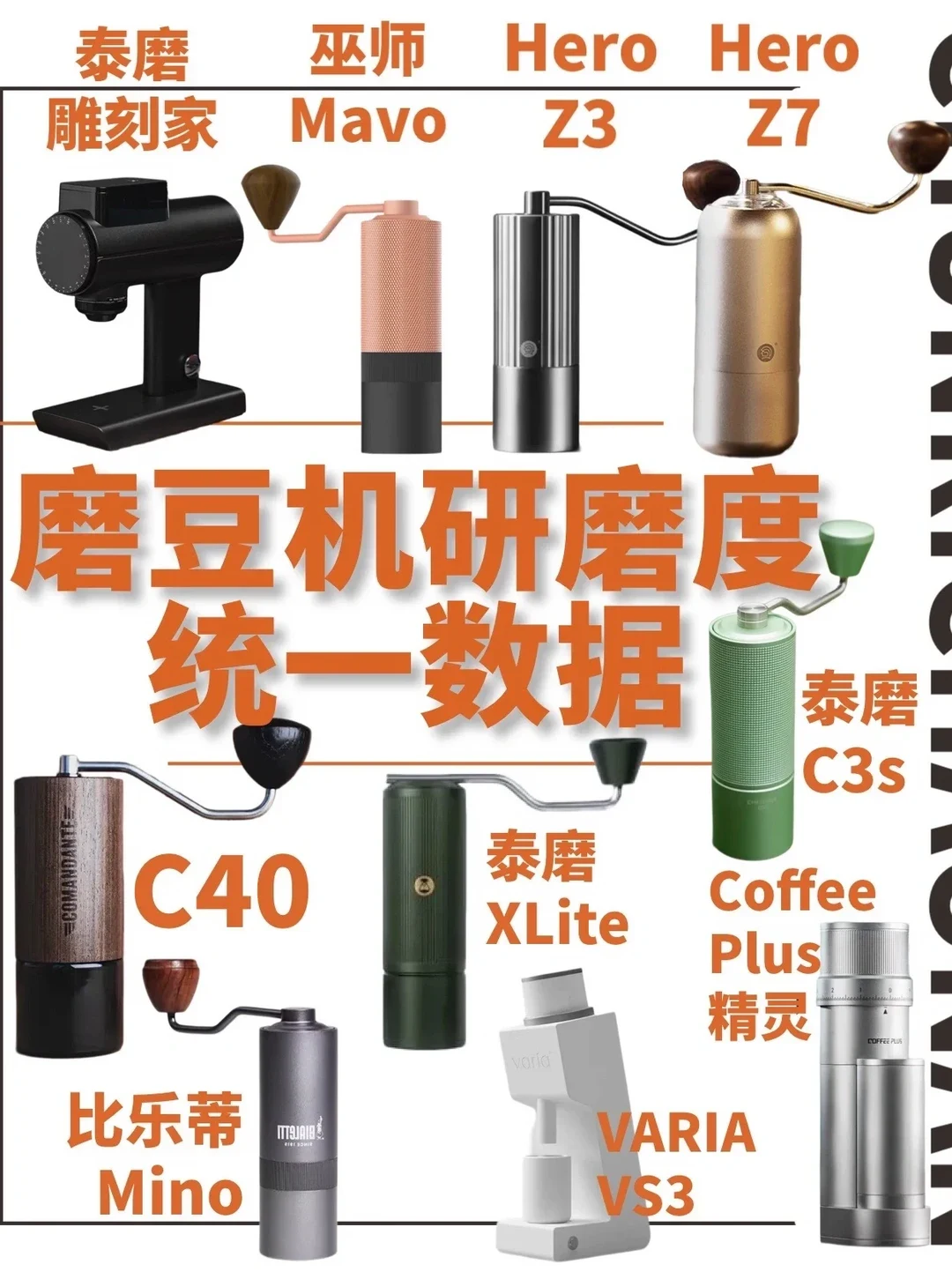
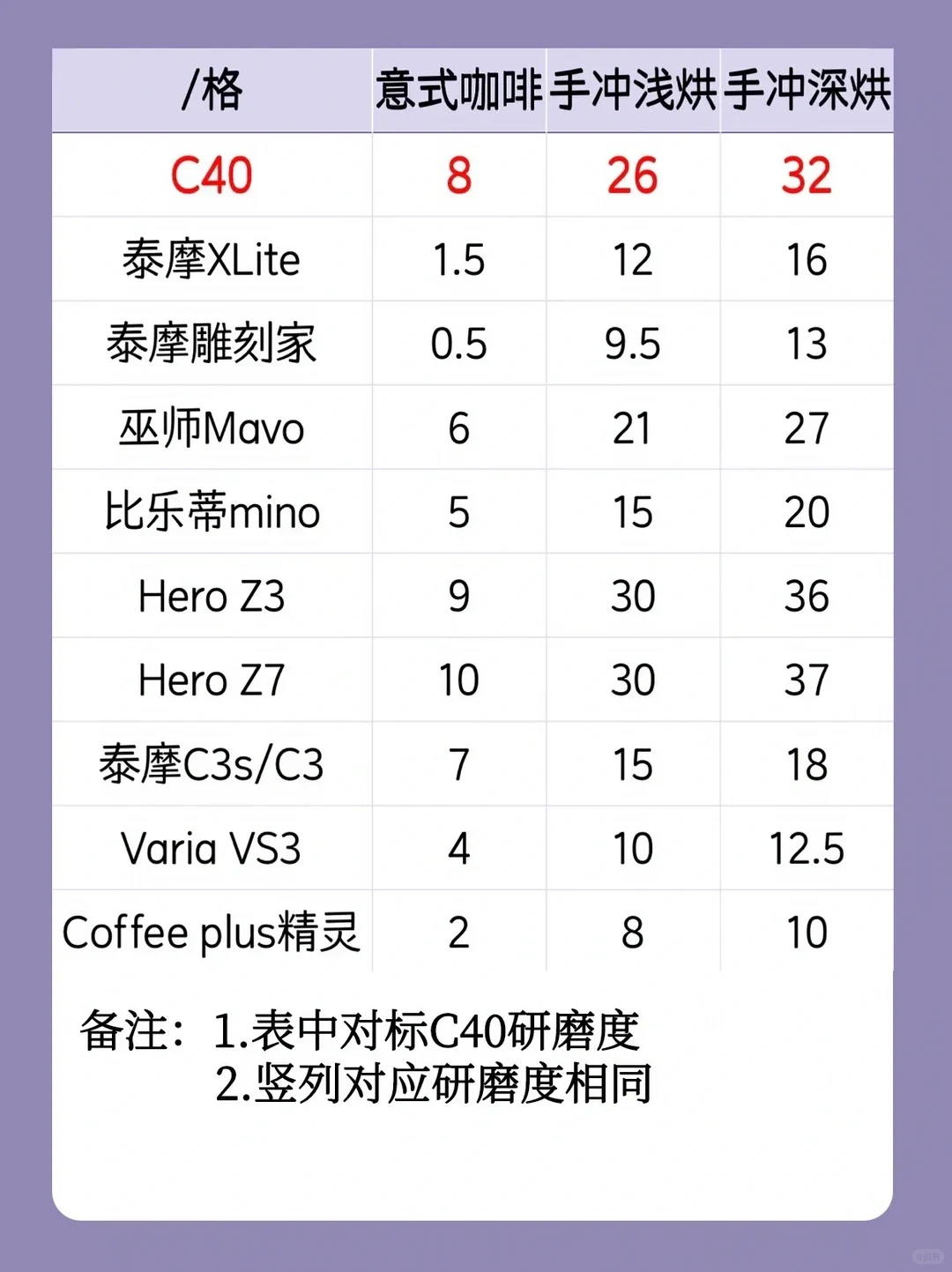
- Grind settings in each column of the chart in Image 2 are approximately equivalent.
- So far, I’ve collected grind settings for espresso with medium-dark roasts, pour-over with light roasts, and pour-over with dark roasts.
- I only have a limited number of grinders. I’d be very happy if you shared additions.
Many people who are new to coffee judge grind size by eye or compare it with the texture of granulated sugar. Neither method is very accurate.
I used standard coffee sieves to analyze the grind settings on the grinders I currently own. The method has limitations, but I think it’s at least more accurate than judging by eye.
Source: 爱喝咖啡的猫叔叔 · Xiaohongshu · 2024-02-07 · 磨豆机研磨度统一表 年度总结(二). Search this Chinese title in Xiaohongshu to find the original post.
Before You Buy
Models in your region
The chart records one author’s approximate comparison across the grinders they had available, using C40 as the reference in its table. The model relationships below identify the named regional counterparts.
| Model in this review | Related regional model | What to know |
|---|---|---|
| Varia VS3 | Varia VS3 (United States) | The US product is directly named Varia VS3. The source chart does not identify its generation or fitted burr. |
| TIMEMORE Chestnut X lite | TIMEMORE Chestnut X lite (United States) | The US counterpart is Chestnut X lite, a distinct model from Chestnut X. |
| TIMEMORE Sculptor series (variant unspecified) | TIMEMORE Sculptor series (United States) | The US Sculptor family is established, but the source SKU is unspecified. That matters because the 078 is stepped, while the 064S and 078S are stepless. |
| MAVO Wizard 1.0 | MAVO Wizard 1.0 (Historical manufacturer reference) | Author comments identify Wizard 1.0, which MAVO’s own history names. Its exact historic US/EU counterpart is unconfirmed; current Wizard 2.0 is a later version, not an established equivalent scale. |
| Comandante C40 | Comandante C40 (United States and Europe through manufacturer-listed dealers) | The plain C40 family is established through US and European manufacturer-listed dealers. The source chart does not identify its generation or click mechanism. |
| TIMEMORE C3s/C3 (source combined row) | TIMEMORE C3s/C3 (source combined row) (United States) | The US catalog lists both C3s and C3, matching the chart’s combined label. The source gives one shared row, not separate calibration results for each model. |
- Model in this review
- Varia VS3
- Related regional model
- Varia VS3 (United States)
- What to know
- The US product is directly named Varia VS3. The source chart does not identify its generation or fitted burr.
- Model in this review
- TIMEMORE Chestnut X lite
- Related regional model
- TIMEMORE Chestnut X lite (United States)
- What to know
- The US counterpart is Chestnut X lite, a distinct model from Chestnut X.
- Model in this review
- TIMEMORE Sculptor series (variant unspecified)
- Related regional model
- TIMEMORE Sculptor series (United States)
- What to know
- The US Sculptor family is established, but the source SKU is unspecified. That matters because the 078 is stepped, while the 064S and 078S are stepless.
- Model in this review
- MAVO Wizard 1.0
- Related regional model
- MAVO Wizard 1.0 (Historical manufacturer reference)
- What to know
- Author comments identify Wizard 1.0, which MAVO’s own history names. Its exact historic US/EU counterpart is unconfirmed; current Wizard 2.0 is a later version, not an established equivalent scale.
- Model in this review
- Comandante C40
- Related regional model
- Comandante C40 (United States and Europe through manufacturer-listed dealers)
- What to know
- The plain C40 family is established through US and European manufacturer-listed dealers. The source chart does not identify its generation or click mechanism.
- Model in this review
- TIMEMORE C3s/C3 (source combined row)
- Related regional model
- TIMEMORE C3s/C3 (source combined row) (United States)
- What to know
- The US catalog lists both C3s and C3, matching the chart’s combined label. The source gives one shared row, not separate calibration results for each model.
A sieve-based reference, not a universal setting chart
The chart spans medium-dark espresso and light- and dark-roast pour-over. The author says corresponding entries within a column are approximately alike in grind size, but does not report the sieve aperture, passing fraction, per-grinder setting units or zeroing procedure. The entries can be compared as reported; they do not establish a universal numerical conversion.
The author presents sieving as a more accurate alternative to judging grounds by eye or comparing them with granulated sugar. That is the author’s rationale for the chart; the source does not provide controlled brewing or flavour results showing that these settings produce identical cups.
Coffee and roast can shift the result
In a later reply, the author noted that bean density and roast affect settings and can leave some error. That qualification supports treating the chart as a starting comparison for the stated brew and roast categories.
Related Reading
Reviews & Guides · Kitchen & Dining
My LAGOM P80: first burr cleaning after six months
I opened my P80 after six months of daily espresso use. There were fines around the edge, and the short supplied hex tool made avoiding the top dial awkward.
Reviews & Guides · Kitchen & Dining
My MAVO Aurora after nearly six months: slow espresso grinding and repeated restarts
I’ve used the MAVO Aurora for espresso for nearly six months. It grinds finely enough, but light-roast beans can take around three minutes and require restarts.

Reviews & Guides · Kitchen & Dining
My Mongdio grinder: espresso flowed fast even at setting 1
I switched from a hand grinder for convenience, but espresso still flowed quickly at setting 1. I described the result and the ensuing return dispute.