
Reviews & Guides · Creative Tools
Bambu Lab A1: smooth silk-PLA lamp print after just over two hours
I printed a large, twisted silk-PLA lamp on the Bambu Lab A1 in just over two hours and found its curved surfaces smoother than expected.
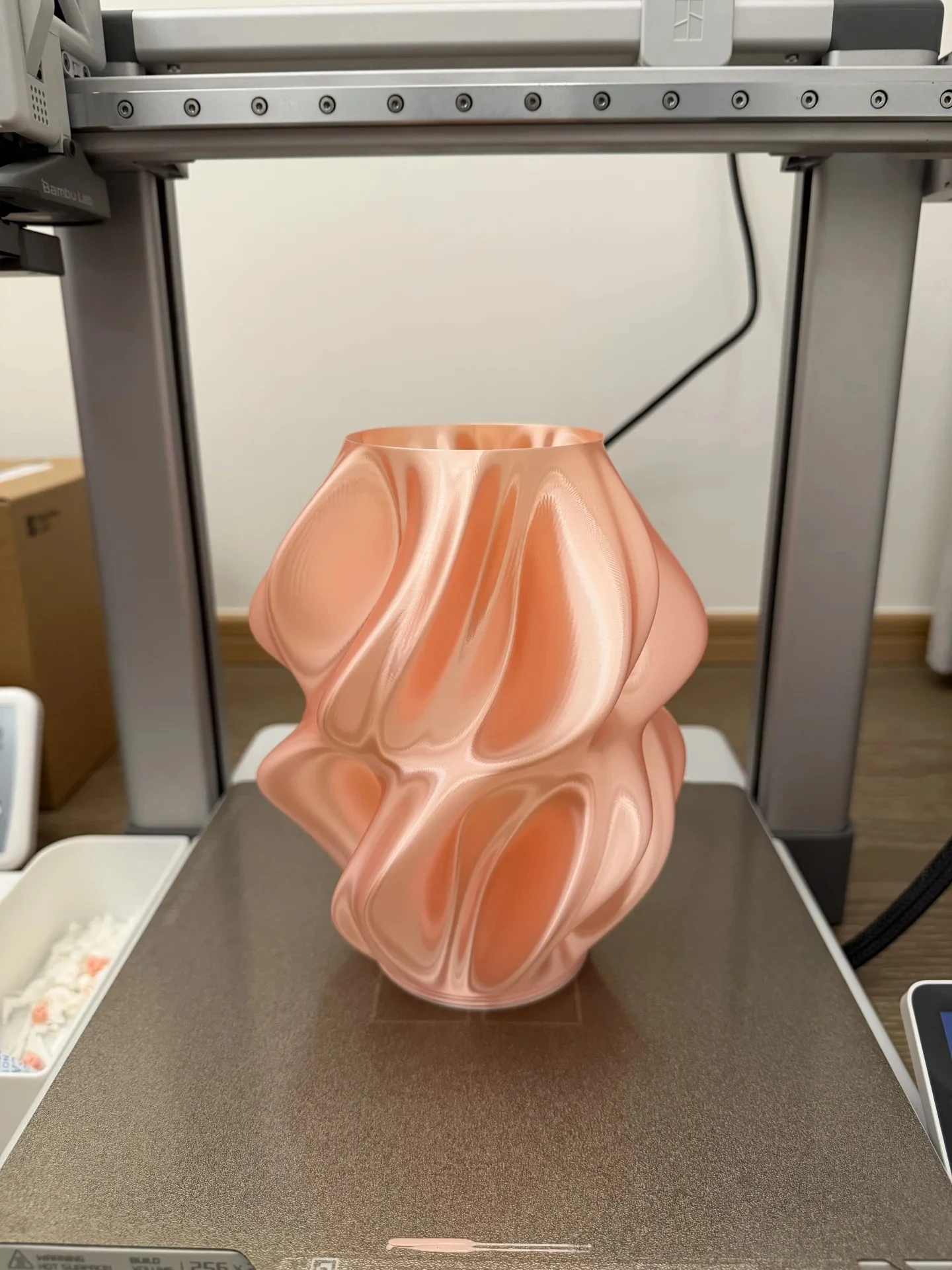
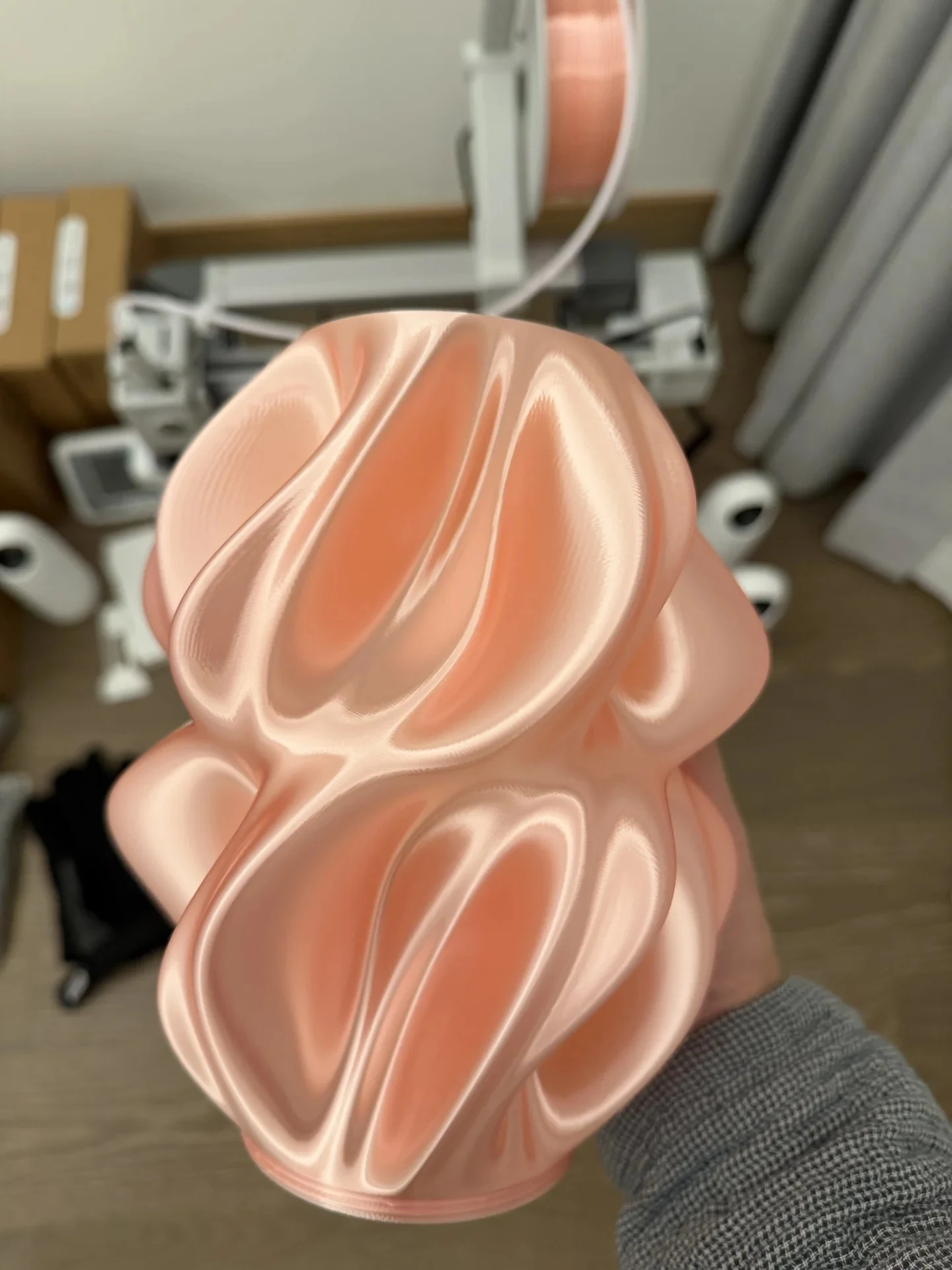
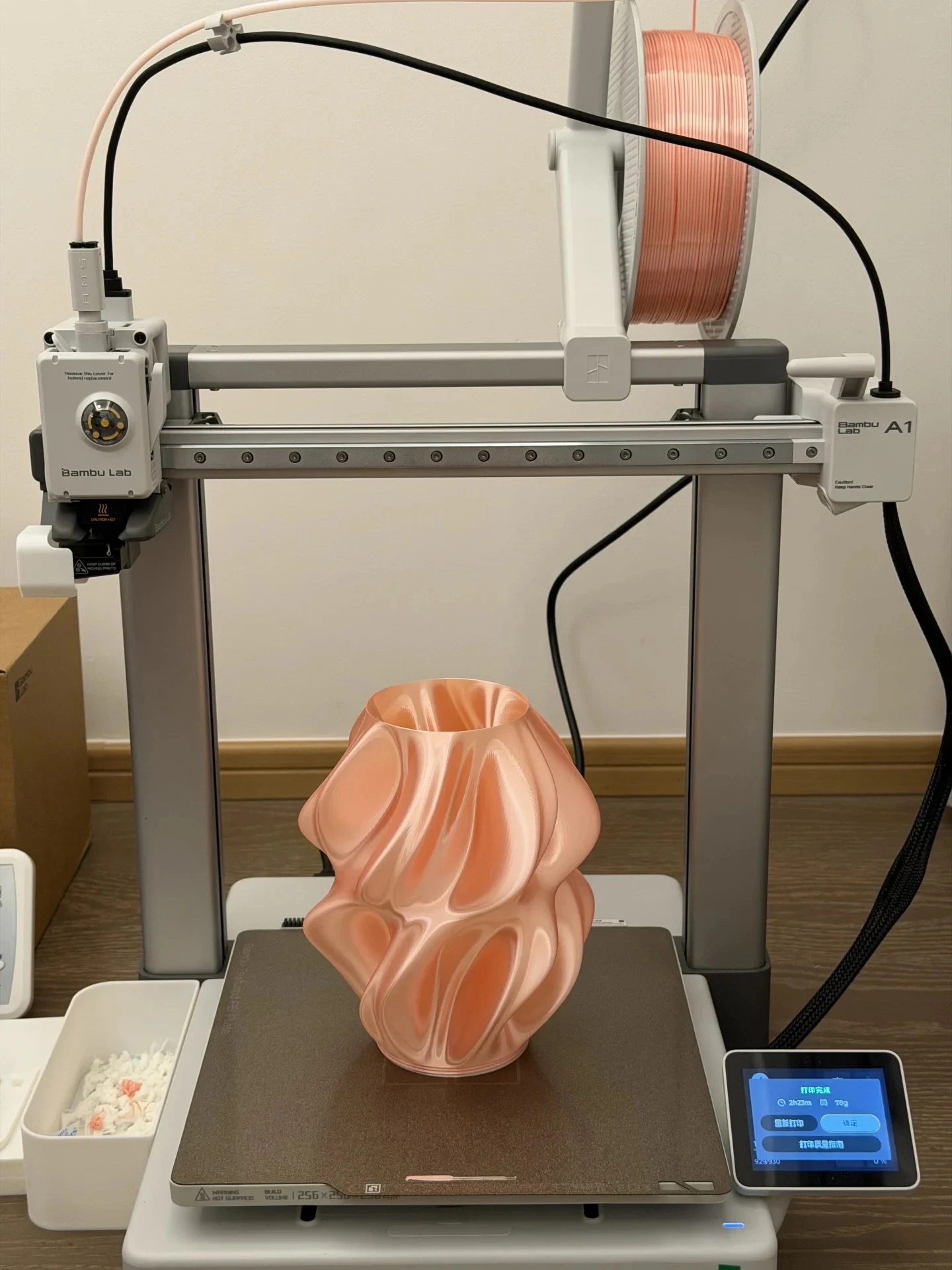
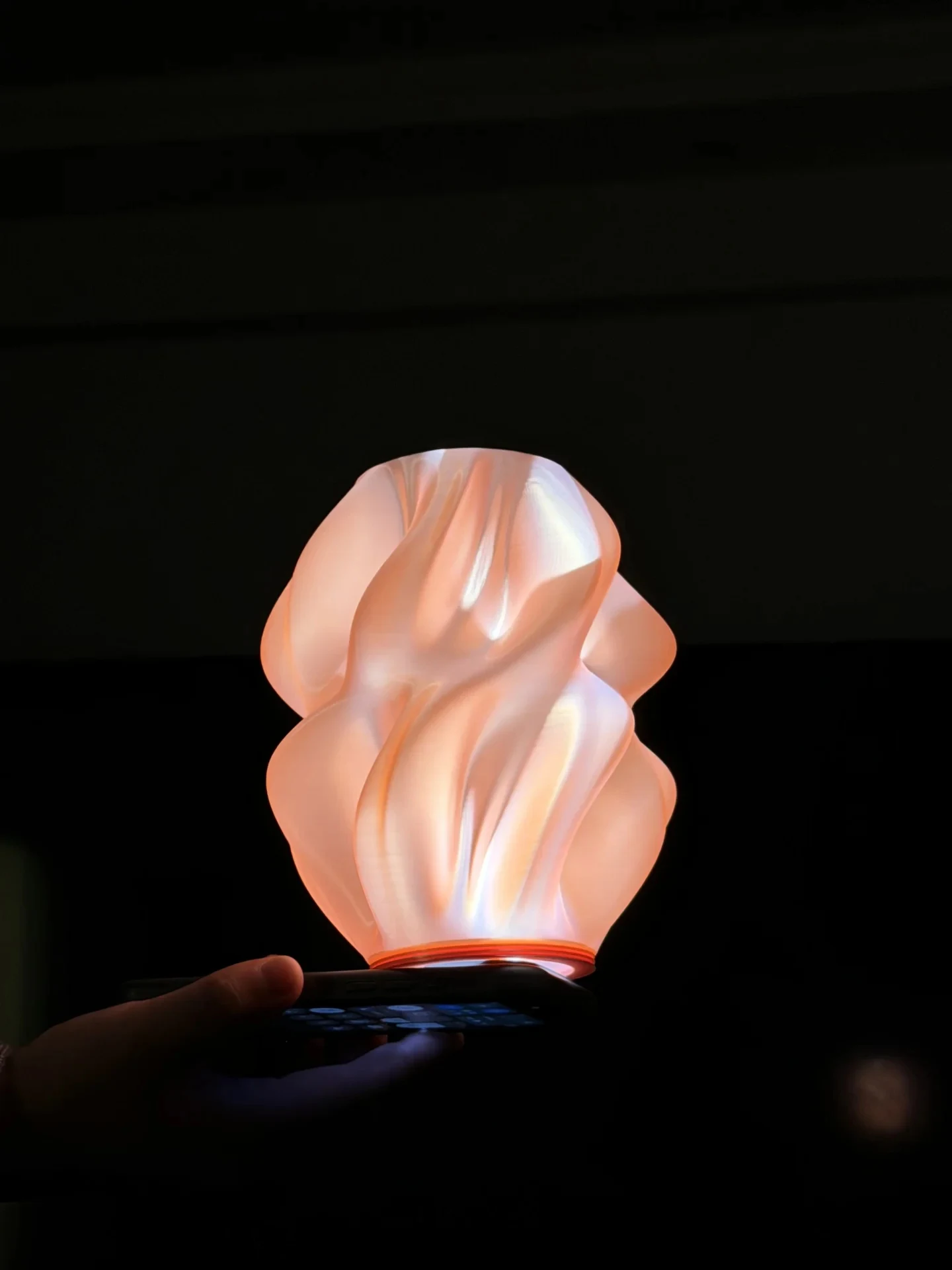
After using the Bambu Lab A1 for a few days, I can say its print quality really is not as poor as people online make it sound.
Before buying the A1, I spent quite a while researching it.
Opinions about the A1's print quality online are very divided. Some people say the A1 is only an entry-level machine and that anyone wanting better surface quality should move up to the P1S or X1C. That made me hesitate before ordering because I was worried I would regret the purchase after seeing the layer lines.
But after actually printing with it for several days, I feel that the A1's print quality is seriously underrated.
This time, I happened to print a fairly complex lamp body using silk pink PLA.
The entire model was made up of irregular curved surfaces, bumps and twisted structures, so I was quite worried that the print might fail. In the end, when I took it off the printer, it looked much better at first glance than I had expected.
The large curved surfaces shown in the photographs were especially revealing. Once silk filament reflects light, it can expose flaws very easily, but the surface actually looked quite smooth and the transitions across the curves were fairly natural. You can definitely see FDM layer lines up close, so there is no point pretending otherwise, but when it is displayed on a table and viewed normally, the overall finish is already very good.
The lamp body was also fairly large. It printed for more than two hours and used about 80 g of filament. I barely supervised it during the process: I sliced the model, started the print and left it alone, and it ultimately finished intact.
That is what I currently find most comfortable about the A1
It is not the kind of 3D printer that requires you to study the machine every day.
It basically handles things such as bed levelling and flow for you. I mainly want to print finished objects rather than constantly tinker with the machine, so it feels genuinely worry-free to use.
Of course, the A1 is not completely without drawbacks.
Its open frame limits the materials you can use, and surface quality is also affected when the print speed is pushed especially high. If you really want more advanced materials and a more enclosed printing environment, the P1S or X1C would certainly be more suitable.
But if you mainly want to print PLA and PETG, make display pieces or lamps, and produce small things for around the home, I now feel that the A1 is more than sufficient.
At least based on my own use, I completely do not get the feeling that a bed-slinging printer automatically has poor print quality.
I even stood in front of the machine and looked at the finished lamp for quite a while.
It gave me a strange feeling
Just over two hours earlier, it had been nothing more than a spool of pink plastic filament, and now it had genuinely become quite an attractive object.
Recently, I have already started searching for models like crazy...
Source: 拿相机的宝盖头 · Xiaohongshu · 2026-08-24 · 拓竹A1真被低估了,这打印质量谁说不行?. Search this Chinese title in Xiaohongshu to find the original post.
Before You Buy
Models in your region
The owner identifies the printer only as a Bambu Lab A1; the exact package and regional variant are not stated. The US, UK and Hungary-facing EU listings below identify the same A1 platform, while package contents, firmware and warranty for a China-purchased unit remain unconfirmed.
| Model in this review | Related regional model | What to know |
|---|---|---|
| Bambu Lab A1 | Bambu Lab A1 / A1 Combo (US) | The US listing identifies the A1 and A1 Combo as variants of the A1. The owner’s exact package is unknown, so this row confirms the platform rather than whether the printer included AMS lite. |
| Bambu Lab A1 | Bambu Lab A1 / A1 Combo (UK) | The UK listing identifies the same A1 platform and offers an A1 Combo with AMS lite. The owner’s package and any market-specific contents are not stated. |
| Bambu Lab A1 | Bambu Lab A1 / A1 Combo (Hungary (EU)) | The Hungary-facing EU listing identifies the same A1 platform and states that AMS lite is included with the Combo. This evidence is specific to Hungary and should not be assumed to cover every EU country. |
- Model in this review
- Bambu Lab A1
- Related regional model
- Bambu Lab A1 / A1 Combo (US)
- What to know
- The US listing identifies the A1 and A1 Combo as variants of the A1. The owner’s exact package is unknown, so this row confirms the platform rather than whether the printer included AMS lite.
- Model in this review
- Bambu Lab A1
- Related regional model
- Bambu Lab A1 / A1 Combo (UK)
- What to know
- The UK listing identifies the same A1 platform and offers an A1 Combo with AMS lite. The owner’s package and any market-specific contents are not stated.
- Model in this review
- Bambu Lab A1
- Related regional model
- Bambu Lab A1 / A1 Combo (Hungary (EU))
- What to know
- The Hungary-facing EU listing identifies the same A1 platform and states that AMS lite is included with the Combo. This evidence is specific to Hungary and should not be assumed to cover every EU country.
What the lamp print shows
The owner's result is a single print, not a general performance test: a large, twisted lamp body in silk pink PLA ran for more than two hours and used about 80 g of filament. The owner reports that it completed intact with little supervision, while still seeing FDM layer lines at close range.
For a display object viewed from normal table distance, the owner's observation is encouraging because reflective silk filament can make surface flaws more obvious. It does not establish that every curved model or speed setting will produce the same finish.
Materials and regional A1 specifications
The official US and UK A1 listings give the printer a 256 × 256 × 256 mm build volume and describe PLA and PETG as ideal materials. They do not recommend ABS, ASA, PC, PA or fibre-reinforced filament, which supports checking material requirements before buying an open-frame A1.
The Hungary-facing EU listing also specifies a 256 × 256 × 256 mm build volume, automatic calibration and active flow-rate compensation. The localized listing is evidence for Hungary, not automatically for every European market; VAT and shipping vary by destination.
Convenience versus a more enclosed machine
The owner values the A1 because bed levelling and flow-related setup require little daily attention. Official listings support automatic calibration, but the owner's hands-off result remains one practical experience with one lamp and does not replace testing other models, materials or settings.
The owner's buying boundary is clear: PLA and PETG projects such as lamps, display pieces and household items suit the A1, while the owner considers the P1S or X1C better for more advanced materials and an enclosed environment. The A1 material guidance reinforces that limitation; compare P1S or X1C specifications separately for your market.
Related Reading
Reviews & Guides · Creative Tools
Bambu Lab A1 Combo: Two Months of Easy Multicolor 3D Printing
I used the Bambu Lab A1 Combo for two months: four-color printing was easy to start, detailed, and convenient, though it wasted some filament.
Reviews & Guides · Creative Tools
Bambu Lab A1: First-Week Precision and Easy Setup
I used the Bambu Lab A1 for a week: unboxing to first power-on took under 15 minutes, a small standard-speed print took 2–3 hours, and Fast mode traded smoother surfaces for speed.
Reviews & Guides · Creative Tools
Bambu Lab A1: One Week of Easy Setup, a Good Benchy Print and Fan Noise
After about 30 minutes of calibration, I could print a good Benchy on the Bambu Lab A1, but taller parts showed layer lines and the cooling fan could get loud.