
PETKIT ULTRA: almost a year of owner notes for Purobot Ultra buyers
I’ve used my PETKIT ULTRA for almost a year. The sealed waste bin and camera help, but the drum feels small for larger cats.
My PETKIT Ultra after almost a year
I show the condition of my PETKIT Ultra after almost a year, explain what I like about waste sealing and the camera, and discuss the limited space inside the drum.
Video unavailable. Please try again later.
Video transcript
A year-long review, of this automatic litter box. I posted the unboxing review video on September 5 last year, so it's just a few days short of a full year now. So how has it been after all this use? First of all, during this year, I never replaced the litter or washed the litter box. I just emptied out all the litter inside, and wiped the inner chamber once with a wet wipe. You can take a look at how clean it is now.
The walls are this clean because I just wiped them with a wet wipe, though there are still a few marks. But the bottom hasn't been cleaned, or washed. When I was using it before, you could see that litter sometimes stuck to the bottom. But once the mineral litter sticks, it falls off on its own. If it sticks to the bottom and you leave it alone, it's gone by the next day. This is what the inside looks like.
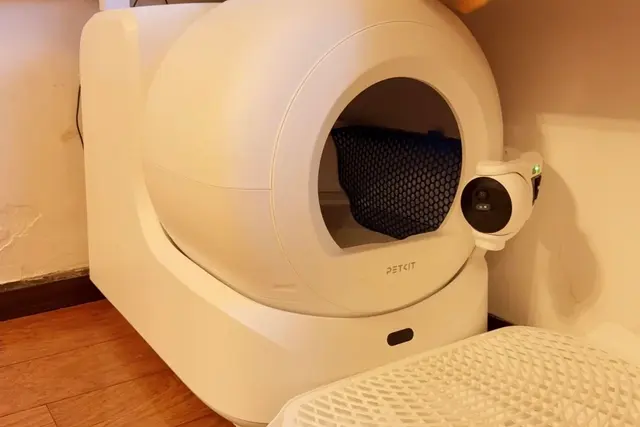
So the inside is very clean. And this is the outside. Now let's open it up here. I just wiped this side with a wet wipe, but I haven't touched any of the other areas on this side. This is what it looks like after a year of use. I wrote the usage method, number of cats, and litter-box settings in the comments, and after using it this way, I found two advantages and one drawback. The biggest advantage, I think, is the waste compartment's odor-locking and automatic bagging functions.
Here's a look inside at the waste compartment. This is the garbage bag. It only opens when you clean it; once you're done, it closes back up. So a major advantage is that the feces and urine clumps inside have very little contact with air, which prevents ammonia from forming. Clumps that don't contact air don't produce ammonia, so we normally wait until it tells us the bag is full before throwing it away. By contrast, with other automatic litter boxes that don't lock in odors as well, especially during a hot summer, we might throw the bag away as soon as we smell something, instead of waiting until it's completely full. Sometimes the bag may need to be changed about every three days to keep it completely odor-free.
So I think that's its biggest highlight. The second advantage is its camera. The camera automatically marks the time each cat enters, so you just tap one to see which cat went in. It's especially convenient for identifying how much each cat has pooped. With many camera features, you might stop using them after a while, but if you only have one automatic litter box at home, you definitely want one with a camera. It lets you know whether the litter box is working normally right now, or whether a cat got a toy stuck inside it and stopped the mechanism.
That matters when you're not at home. It's especially important. The one shortcoming is that the litter chamber is too small—about 70 liters, I think. It's only suitable for cats weighing around five to five and a half kilograms. Larger cats, long-haired cats, or cats that need more space in the litter box may not want to use it.
Before You Buy
Models in your region
The owner identifies the product as the camera-equipped PETKIT ULTRA, but does not provide a full model number. The official US and UK products listed below are the PETKIT Purobot Ultra P9903; the shared rotating, camera-equipped design suggests a relationship, but exact Chinese hardware and firmware equivalence is unconfirmed.
| Model in this review | Related regional model | What to know |
|---|---|---|
| PETKIT ULTRA with camera (source product; Chinese-market version) | PETKIT Purobot Ultra P9903 (US) | The full Chinese model number is not provided. The official US comparison is the PETKIT Purobot Ultra P9903, a camera-equipped rotating litter box with automatic waste sealing and bag fitting, but exact regional equivalence is unconfirmed. |
| PETKIT ULTRA with camera (source product; Chinese-market version) | PETKIT Purobot Ultra P9903 (UK) | The official UK comparison is the PETKIT Purobot Ultra P9903, which has a rotating camera and 10-litre waste compartment. Its shared design links it to the source Ultra, but exact Chinese hardware and firmware equivalence is unconfirmed. |
- Model in this review
- PETKIT ULTRA with camera (source product; Chinese-market version)
- Related regional model
- PETKIT Purobot Ultra P9903 (US)
- What to know
- The full Chinese model number is not provided. The official US comparison is the PETKIT Purobot Ultra P9903, a camera-equipped rotating litter box with automatic waste sealing and bag fitting, but exact regional equivalence is unconfirmed.
- Model in this review
- PETKIT ULTRA with camera (source product; Chinese-market version)
- Related regional model
- PETKIT Purobot Ultra P9903 (UK)
- What to know
- The official UK comparison is the PETKIT Purobot Ultra P9903, which has a rotating camera and 10-litre waste compartment. Its shared design links it to the source Ultra, but exact Chinese hardware and firmware equivalence is unconfirmed.
Odour control and bag handling
The owner especially likes the waste compartment, saying the bag stays closed except during cleaning and limits air contact with faeces and urine clumps. They now wait for the full-bag alert rather than changing it after roughly three days in hot weather. This is their source-version observation, not a universal result for every regional model.
For the official US Purobot Ultra P9903, PETKIT says the system uses automatic waste sealing and fresh-bag fitting, but the FAQ says packing cannot be initiated in the app: someone must press the OLED control, remove the sealed bag and double-click to fit a new one. Buyers should therefore not assume the owner’s automatic-packing workflow means remote packing on the US model.
The UK P9903 also lists automatic sealing and bag fitting, while its FAQ requires a person at the device to start packing, remove the sealed bag and trigger replacement. Its claimed up-to-20-day duration is a one-cat laboratory figure, not a maintenance schedule for multiple cats.
Camera usefulness when you are away
The owner uses the camera to review each cat’s entry event, identify which cat used the box and judge how much each cat eliminated. The owner also values it as a status check: when only one automatic litter box is available, the camera can help reveal whether a toy has jammed the mechanism while nobody is home.
The official US and UK Purobot Ultra listings identify a rotating camera. The owner’s specific cat-recognition and elimination-tracking experience comes from the Chinese-market product; the supplied regional excerpts do not verify those app functions.
Cleaning, sticking and drum space
After almost a year, the owner says they had not changed the litter or washed the box. In the filmed check, the owner emptied the litter and wiped the inner drum once; the walls still showed some marks, while the bottom had not been cleaned. The owner reports that mineral litter could stick to the bottom but usually fell away by the next day if left alone.
This is a single owner’s usage history, and the owner says their usage method, cat count and settings were given in the comments. It demonstrates the condition of their machine after that routine, rather than proving that every litter type, household or cleaning interval will produce the same result.
The owner estimates that the drum holds about 70 litres and says it suits cats around 5–5.5 kg, while larger or long-haired cats and cats that prefer more room may reject it. The official US and UK pages provide regional limits and dimensions but do not verify that this owner’s estimated internal volume or comfort judgment applies to those versions.
For regional buying, the US P9903 is listed at 532 × 818 × 612 mm, weighs 14.6 kg, runs on 12 V DC at 4 A and recommends cats weighing 1.5–10 kg. The UK guidance calls for firm level flooring with 5 cm wall clearance and clumping litter no longer than 12 mm and no wider than 3 mm; fast, tight clumping is intended to reduce smearing.
Related Reading
Reviews & Guides · Appliances
PETKIT Ultra: first two weeks with four cats, with Purobot Ultra buying context
After two weeks with a PETKIT Ultra and four cats, I found the waste bin filled in about three days. My old litter box needed scooping twice daily.
Reviews & Guides · Appliances
PETKIT Ultra: a year of odor control and cleaning, with Purobot Ultra buying context
After a year with my PETKIT Ultra, I appreciate the odor control and automatic bagging. Stuck litter and washing the large drum are still awkward chores.
Reviews & Guides · Appliances
PETKIT PURA X: Four Years With Four Cats and a Replacement
I used a PETKIT PURA X with four cats for four years before its controls stopped responding, then bought another because its footprint still suited my space.