
Google Fitbit Air: two weeks of app use, battery and wear
I wore Fitbit Air for two weeks, finding 9–10-day battery life and a remarkably light design while comparing Fitbit and Google Health sleep data.
After using Fitbit Air for two weeks, I’m mainly sharing my experience with the apps this time.
Before discussing the apps, I’ll first cover battery life and wear.
- The official battery claim is seven days, but I measured 9–10 days with daily commuting and six hours of high-intensity exercise each week. Charging is also very fast: it takes about ten minutes to go from 20% to 80%. I always charge it to 80%; apparently, that is better for the battery.
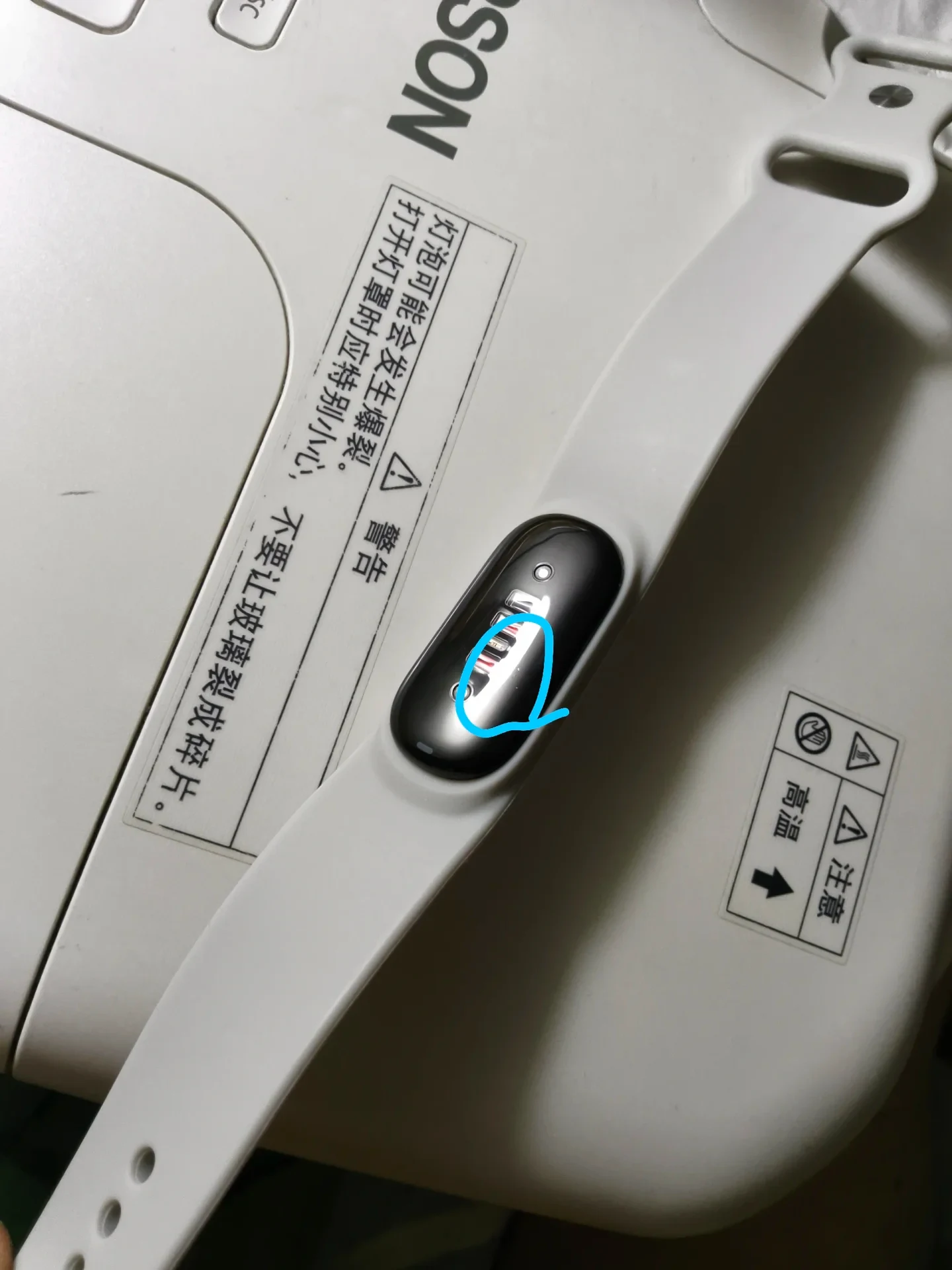
- The tracker is fairly prone to scratches. I was still very careful with it, but it may have been scratched by hard particles on clothing because I often wiped it with my clothes, as shown in image 1. There are more serious examples on Reddit, where sunscreen and DEET-containing insect repellent severely corroded the surface. The plastic material really does need attention. I no longer apply skincare essence to the wrist wearing the tracker; apparently, skincare essence can also corrode the casing.
Two apps compared
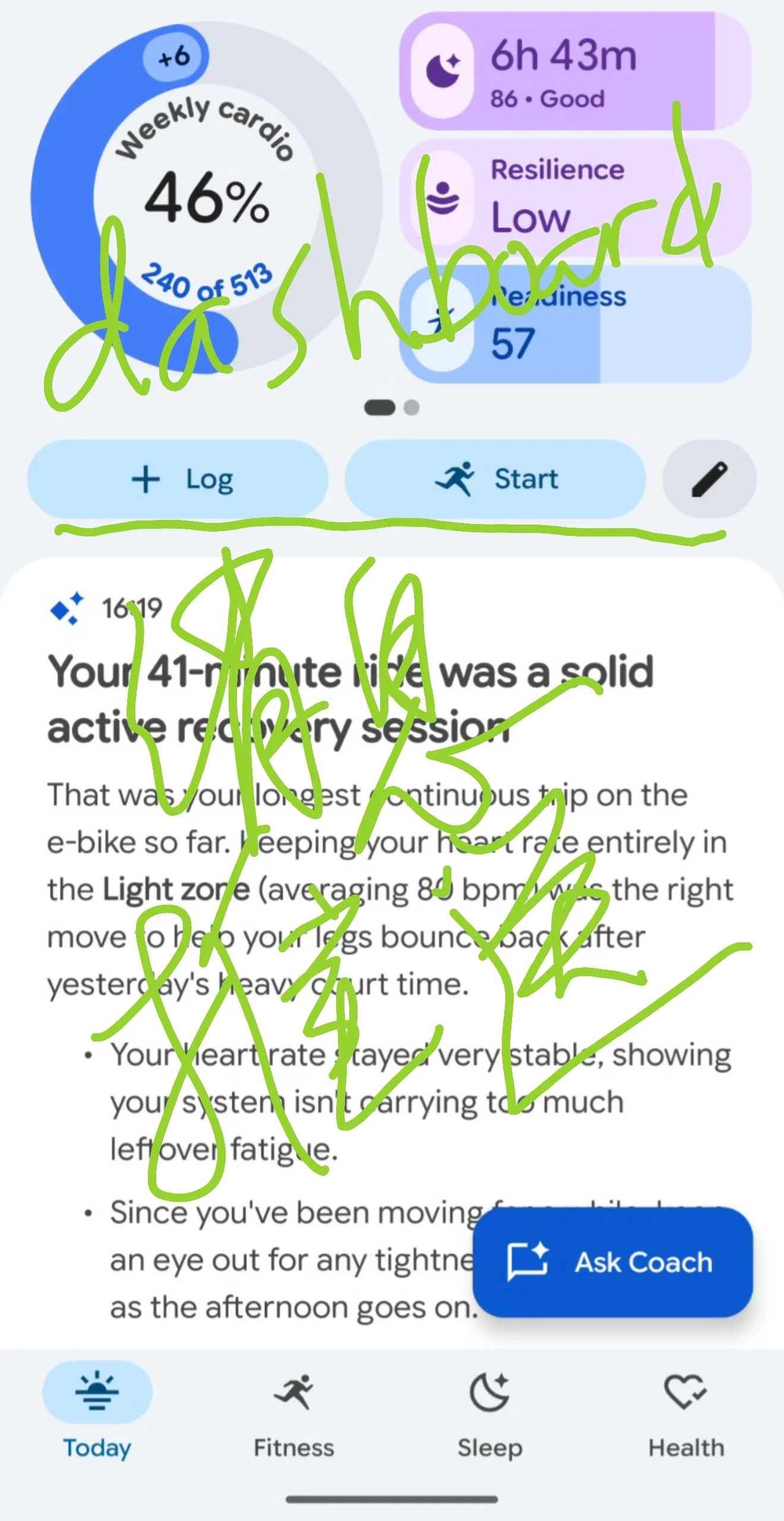
Compared with Fitbit, GH (Google Health) feels more like a child’s logic and intuition: the information is too scattered, without good logic or organization. As shown in image 2, GH changed the interface for Fitbit Air so that one-third is used for the dashboard and two-thirds for activity and automatically detected movement notifications. It completely caters to this screenless tracker while sacrificing the Pixel Watch family.
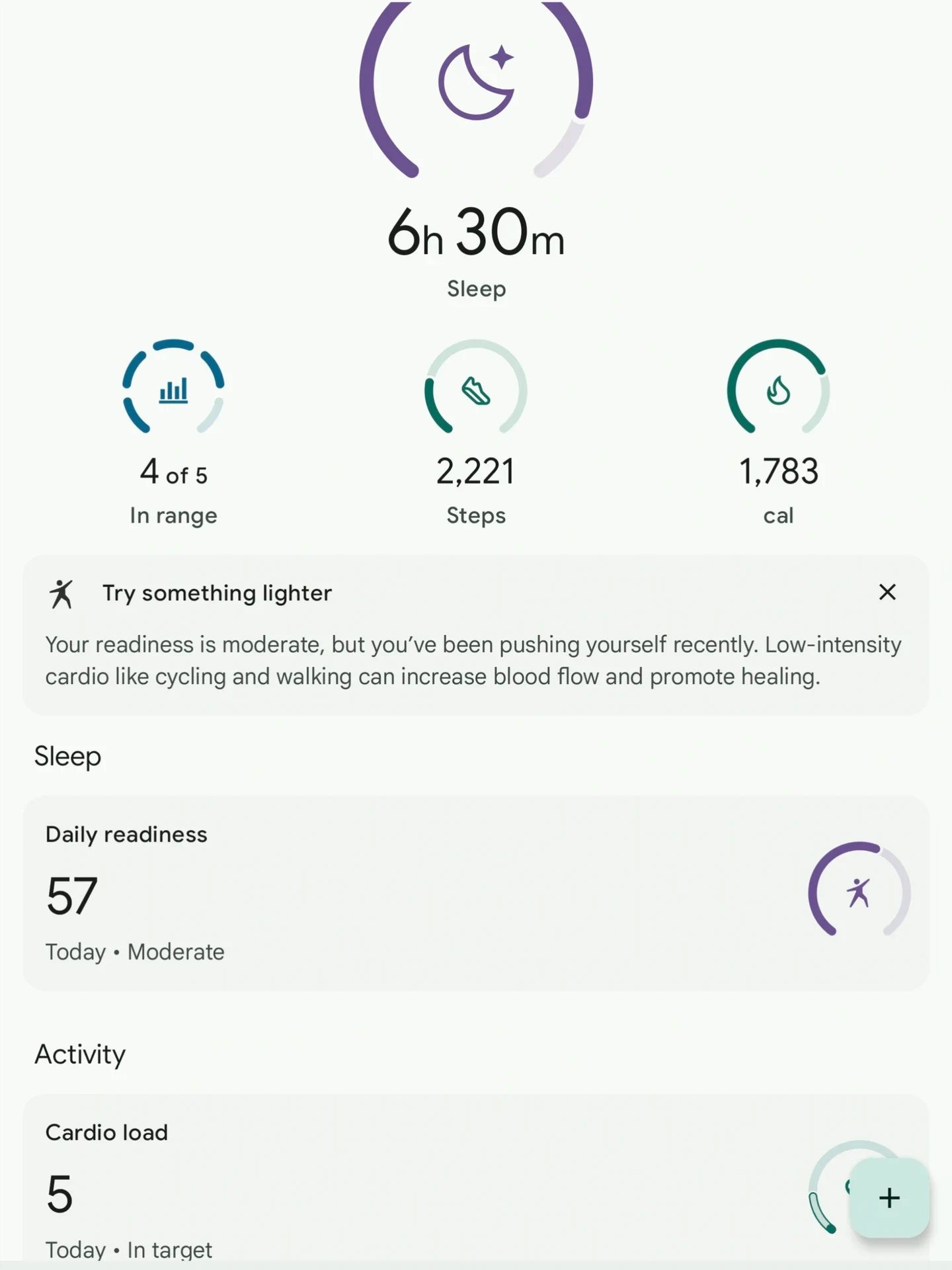
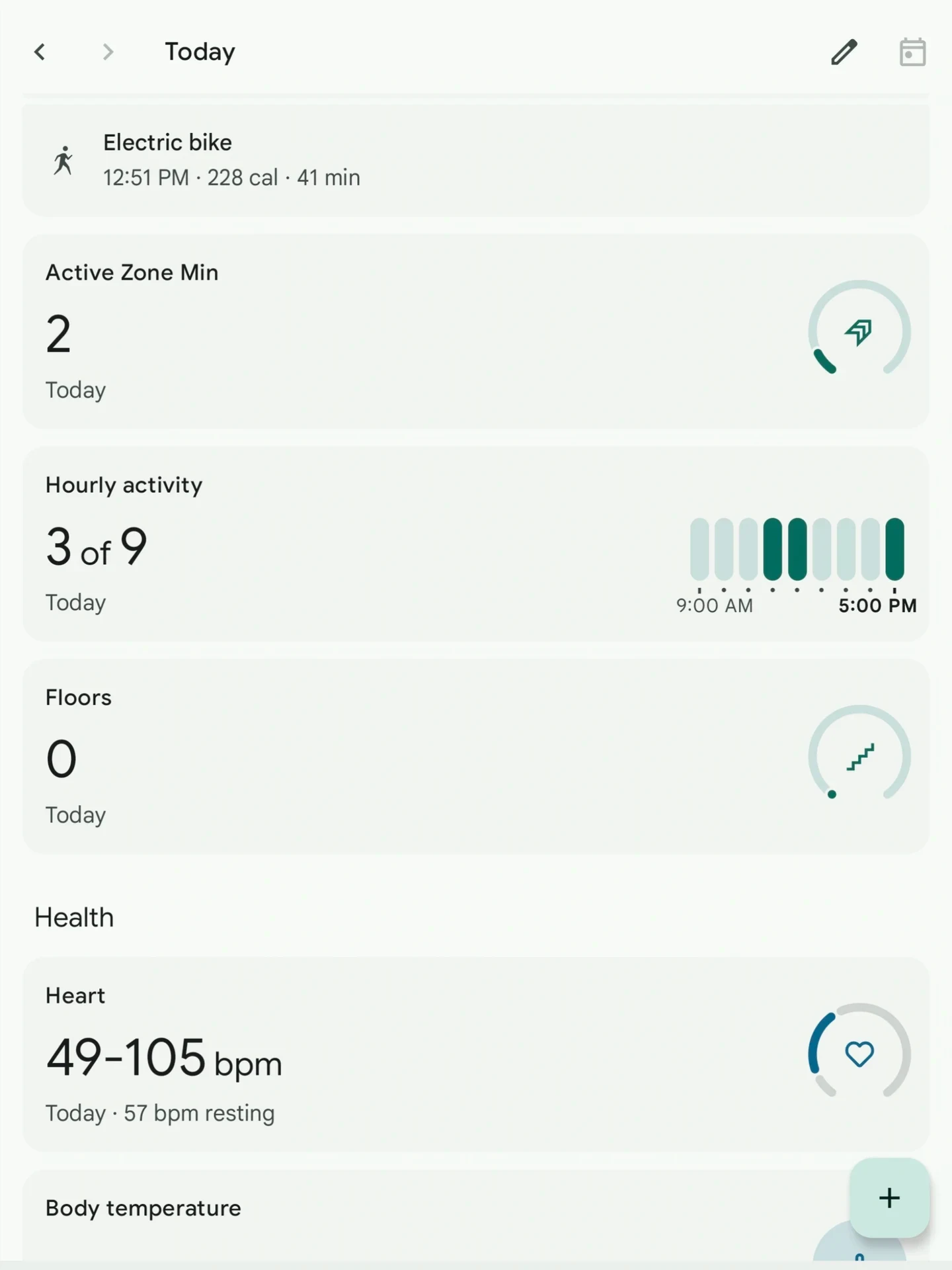
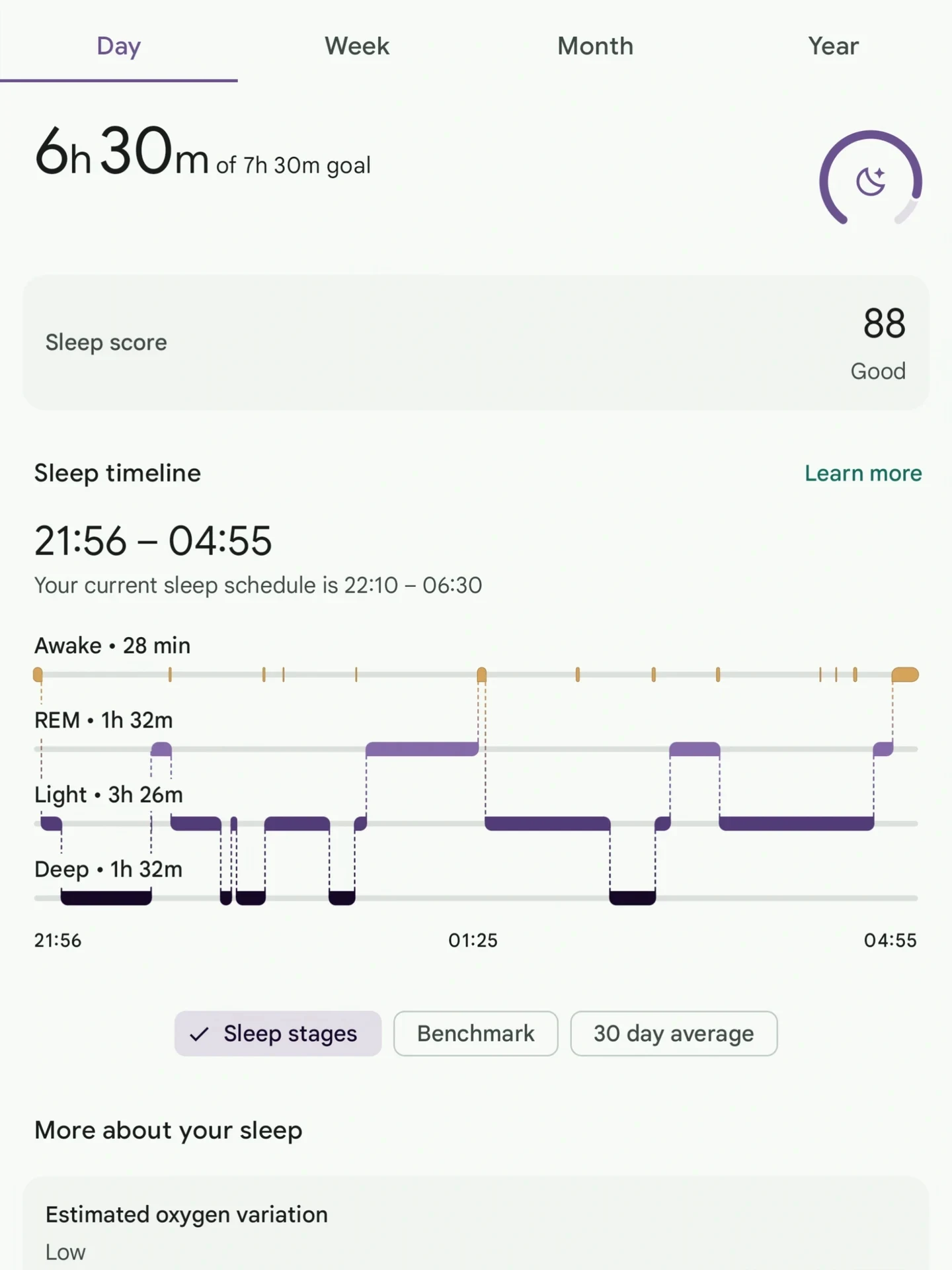
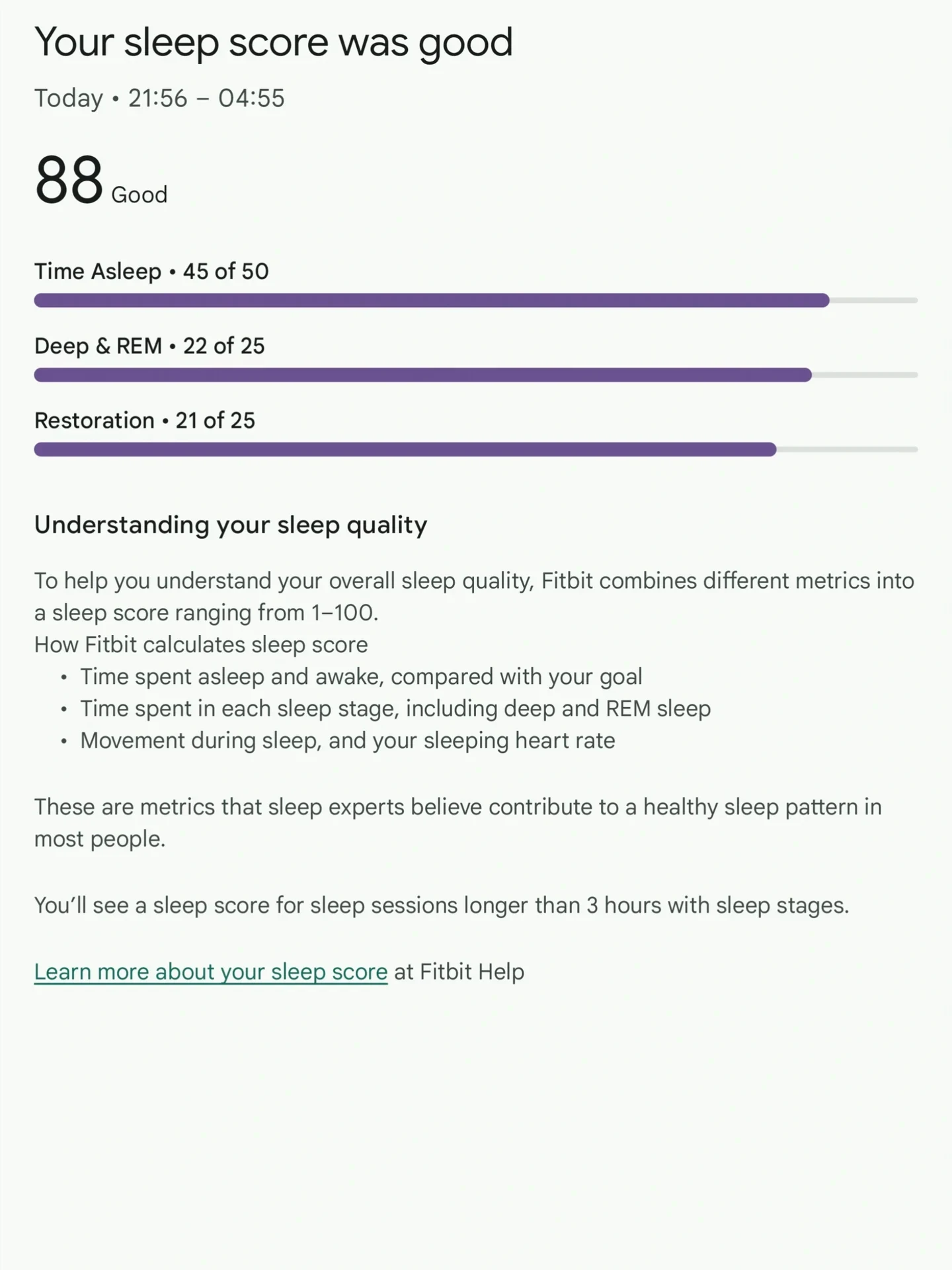
Images 3–6 show that Fitbit’s information summaries and organization are very intuitive. Each level of tapping reveals more detail, whereas GH does not work intuitively in this way and scatters information in different places. No wonder some people say GH was “vibe coded.” We’ll see whether future updates bring major changes.
Regarding the data, after using GH with Fitbit Air for two weeks, its resting heart rate began to trend toward Fitbit’s results; early on, it was consistently a little higher. For sleep data, Fitbit defines awake periods more generously, while GH counts only awake periods longer than five minutes. As a result, Fitbit reports a shorter sleep time, but its score is higher than GH’s.
Finally, there is the Premium Ask Coach feature. You can search for the activation method yourself. One point to note: avoid automatic proxy-server selection. During these three free months, I feel it can teach some basic knowledge about exercise recovery and diet. Coincidentally, I felt unwell after exercise twice in the past few weeks, something I had not experienced for many years. Through GH, I learned about recovering at home, eating more healthily and judging whether I should go to hospital. I plan to ask more questions and learn more during the remaining free period, hoping to learn some basic knowledge before it ends.
The recovery advice I remember most clearly was to keep warm. At first, I wondered whether this was based on traditional Chinese medicine because I had asked the question in Chinese. Later, Scott, the coach, told me it was based on sports-science recovery theory. It reminded me that my parents had always told me to wear more layers and keep warm. Sometimes our prejudice against our parents runs too deep.
Overall, I still really like Fitbit Air. I was so eager that I sold my Pixel Watch and have decided to wear this tracker all the time. Its slimness is especially impressive—almost perfect. It is far better in this respect than my previous watch.
Source: 小红薯64D9F2B7 · Xiaohongshu · 2026-07-03 · **大陆IP** Fitbit Air两周使用体验-终结篇. Search this Chinese title in Xiaohongshu to find the original post.
Before You Buy
Models in your region
The owner calls the tracker Fitbit Air, while Google’s US and UK store pages identify the corresponding product family as Google Fitbit Air. Those regional pages list up to seven days of battery life, a 12 g weight with band and support for Google Health, but they do not establish that mainland-China account access, accessories or warranty terms are identical.
| Model in this review | Related regional model | What to know |
|---|---|---|
| Google Fitbit Air | Google Fitbit Air (US) | The US Fitbit Air is rated for up to seven days of battery life and weighs 12 g with its band. It uses Google Health on a compatible phone. |
| Google Fitbit Air | Google Fitbit Air (UK) | The UK model shares those headline battery, weight and phone specifications. Mainland-China use does not establish official Coach access there. |
- Model in this review
- Google Fitbit Air
- Related regional model
- Google Fitbit Air (US)
- What to know
- The US Fitbit Air is rated for up to seven days of battery life and weighs 12 g with its band. It uses Google Health on a compatible phone.
- Model in this review
- Google Fitbit Air
- Related regional model
- Google Fitbit Air (UK)
- What to know
- The UK model shares those headline battery, weight and phone specifications. Mainland-China use does not establish official Coach access there.
Battery life and casing care
The owner reported 9–10 days between charges with commuting and about six hours of weekly high-intensity exercise, longer than Google’s up-to-seven-day rating. Their roughly ten-minute charge covered 20–80%; Google’s 90-minute specification is for 0–100%, so the starting and ending levels matter.
The owner noticed scratches and suspected wiping with clothing, while the sunscreen and DEET damage was reported from Reddit rather than their own test. Google identifies the casing plastics but the cited specifications do not establish compatibility with those chemicals or skincare products.
App organization and sleep data
The owner found Fitbit’s summaries easier to follow because successive taps revealed more detail, while Google Health scattered information across the interface. This is a personal usability judgment after two weeks, so it indicates a likely learning preference rather than a measured app-performance difference.
The owner believed Fitbit counted more time as awake, while Google Health counted only waking periods longer than five minutes. Their Fitbit total was shorter yet scored higher. These are the owner’s observations, not an official statement of either algorithm, so compare each app’s scores within its own context.
Health Coach access and limits
The owner found the three-month free Ask Coach period useful for learning about exercise recovery, diet and when to seek medical care, including advice received after two uncomfortable post-exercise episodes. That account describes educational use, not a clinical result; Google says Health Coach provides informational guidance rather than medical advice and that AI can make mistakes.
Google officially lists Health Coach in countries including the US, Canada, the UK, Germany and France, but not mainland China or Hong Kong in Google’s support information. The owner’s access experience therefore does not prove official availability there, and buyers should confirm local eligibility, account requirements and network conditions before relying on the feature.
Fit and everyday wear
The owner ultimately sold a previous Pixel Watch and chose to wear Fitbit Air continuously, chiefly because its slimness felt much better than a watch. Google lists the tracker at 12 g with band and 5.2 g without band, which supports the product’s lightweight positioning; those specifications do not measure comfort for every wrist or confirm the owner’s individual fit.
Related Reading
Reviews & Guides · Wearables
Google Fitbit Air: three-day owner notes on fit, sleep and regional AI Coach access
My Fitbit Air battery fell from 100% to 76% in three days. Cycling and walking were detected automatically, but strength training needed manual entry.
Reviews & Guides · Wearables
Google Fitbit Air: a three-week owner review of fit, battery and AI coaching
I wore the 12g Google Fitbit Air day and night for three weeks, charged it weekly, and found its AI coach surprisingly specific about training and recovery.
Reviews & Guides · Wearables
Google Fitbit Air owner review: light, screen-free tracking with slow responses
I liked Fitbit Air's light fit and interactive logging enough to order a Timex Weekender, but slow replies and incomplete split-sleep records frustrated me.